Tag Archives: meditation

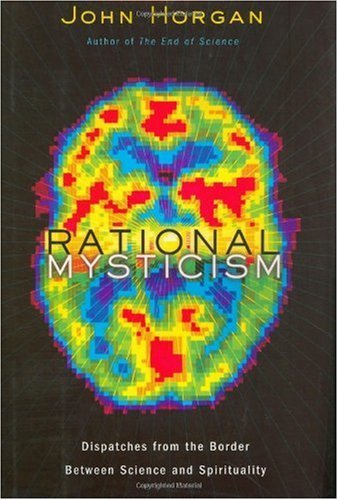
RATIONAL MYSTICISM by John Horgan

rational-mysticism

This is a book I thought long and hard about highlighting. I expected great things and was overall disappointed. Unfortunately John Horgan is a reductionist materialist and despite the access he had to various spokespeople on mysticism, he remains thoroughly unconvinced. He is a science writer who holds the dogmatic party line through the entirety of the book. That said, I think some valuable perspective can be gleaned from the people Horgan talks to. It’s worth the read to get an overall feel for the modern history of the topic and hear from some of the players.

Horgan begins with a definition of mysticism within the historical context. He interviews Huston Smith who discusses mysticism as a cross-cultural, cross-religious experience. Smith represents the notion of the perennial philosophy. The author’s search next takes him to a two day conference in Chicago where mysticism is treated as a literary phenomenon. These scholars know in great detail the texts left behind by Eckhart, St. Teresa of Avila, Shankara, etc. But sadly, none of them has any personal experience with anything remotely mystical. The journey continues with an interview of Ken Wilber dubbed ‘the weightlifting Bodhisattva’ by Horgan. Wilbur stands behind Smith adhering to the perennial philosophy but also embraces science as a way to explore and define mystical experience.
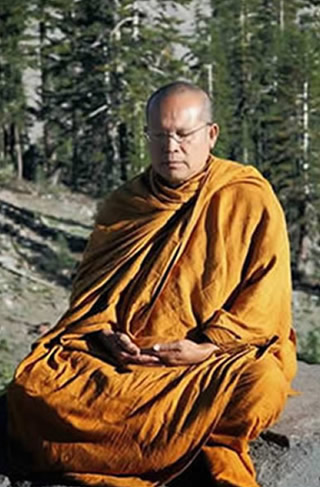
meditating

Photo: Thanabadhi

Important information is raised in the chapter called Can Neurotheology Save Us?. Horgan visits with Andrew Newberg, the doctor featured back in 2001 in Newsweek’s article, “God and the Brain: How We’re Wired for Spirituality.” Wouldn’t it be nice if brain scans could prove mystical states and help us to understand them? Unfortunately, a review of data collected on all sorts of meditation doesn’t support any nice clean conclusions according to Jensine Andreson, a theology professor at Boston University. And that in turn brings into question all the benefits touted for meditation. A review of the studies looking at meditation and its benefits Andreson believes, are poorly designed and won’t hold up to scrutiny. Of course, as it relates to mystical practice, mystics don’t meditate to lower their blood pressure but I would concede that a whole lot of Americans do increasingly view meditation as a health practice. Should they?

Continuing the scientific pursuit of mystical states, Horgan interviewed Michael Persinger of Laurentian University, Canada. Starting in the 1980s, Persinger began studying the brain’s response to electro-magnetic pulses to certain areas of the brain. 40% of Persinger’s test subjects experience a presence. The Canadian magazine Mclean’s called this device, “the God machine.” Persinger maintains that he has not addressed the God question with his work, rather his interest is in understanding the electrical pattern of the brain that leads to religious belief. But does the machine produce mystical experiences? No. Apparently, no one tested has reported the typical sensations of bliss, unity, or ineffability commonly reported by mystics. Scientific attempts to link temporal lobe excitation or epilepsy to mystical experience do not hold up either.

brain-scan

Horgan next turns to practitioner of Zen and neurologist, James Austin who penned the book, Zen and the Brain. Austin calls his approach perennial psychophysiology. Instead of gaining metaphysical insight, Austin thinks the mystic undergoes deep changes in personality. Someone who has had these experiences becomes more stable, more compassionate, and more selfless. As a specialist in brain disorders, Austin attempts to separate healthy mysticism from other illnesses. His approach relies on the idea that mystical experience releases excitotoxins which cause the loss of neurons. This in turn, allows us to get rid of those things that distort our view of reality. This is as scary as it is fascinating. For me, it makes mystical experience similar to brain damage. Can that really be?

No book on mysticism would be complete without a foray into drug induced mystical experience. Horgan looks at the history of LSD, DMT, and ayahuasca. He visits Stanislov Grof, who is involved in the transpersonal psychology movement. Grof believes that we must move into a new paradigm where mind has primacy over matter (the book was published in 2003, not a unique idea now). There’s an interesting discussion of Rick Strassman’s work as outlined in DMT: The Spirit Molecule. The colorful Terrence McKenna makes an appearance in a later chapter where he advocates the use of psychedelics.
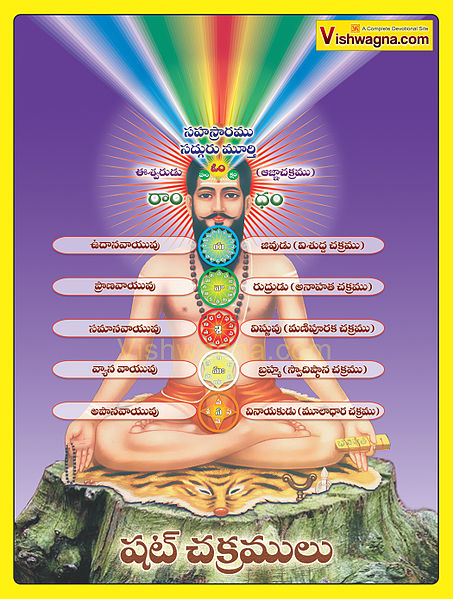
chakra

Photo by: vishwagna.com

The book is a nice romp through lots of questions with little in the way of conclusions. I often had the feeling that the author was totally out of his depth. Why did this topic appeal to him? He remained a science writer who attempted to fill pages. Most of them are interesting. I wonder what the book would have looked like with another author or even what the book would look like if updated.

 

https://amzn.to/30oq1NL

14 Comments

Filed under Book Review, Uncategorized

WIN A SIGNED BOOK!

After Jupiter Gardens Press went belly up, I struggled with whether or not to do the self-publishing thing. Turns out, it was easier than I expected. I am excited to announce the launch of my first self-published book! I worked with the fabulous Anna Spies at EerilyFair to create a cover I truly love. Thanks, Anna! Now it’s time to share the love. I will be giving away 4 signed paperback copies of Into the Land of Snows using a random drawing (US residents only, since I have to mail them). The contest will run from today until noon Aug. 11 (next Thursday). Enter by leaving me a comment about something fun you did this summer.

1800x2700

About the book: Visionary Fiction 

Sixteen year old Blake travels to Base Camp on Mt. Everest to spend time with his physician father. When a deadly avalanche occurs, Dad is forced to rethink things and sends Blake away. Now accompanied by a Sherpa guide, and in possession of a mysterious camera, Blake undertakes a journey that will challenge everything he believes. In the magical Himalayas, he will be forever changed by what he experiences.

Available on Amazon: https://goo.gl/6HUnDX

ebook ($4.99):  https://goo.gl/mbHZsr

WHAT READERS ARE SAYING:

“Well-written with engaging and believable characters, this story has it all: adventure, mystery, magic, and wisdom.” Naomi C. Rose

“Into the Land of Snows is a eminently readable YA novel that moves quickly and adeptly through many mystical twists and turns. A very fast and enjoyable read! I recommend it highly to YA audiences, but to adults as well.” Rea Nolan

“Into the Land of Snows takes the reader into a world so different, so beautifully challenging in its vision of life that the reader is drawn-in completely. So strong is the vision presented in this book it may even change the being within you.” Karin DeMer


20 Comments

Filed under Books, Uncategorized

SNEAK PEEK

intothelandofsnowsmall

With Jupiter Gardens closing its doors, I’ve decided to re-release INTO THE LAND OF SNOWS. I’ve had an amazing time working with Anna Spies of EerilyFair (https://www.facebook.com/eerilyfairdesign/). She is a talented and imaginative cover designer and here’s a peek at the new cover design. Freakin’ awesome job!

As part of the process, I got to view photos of teenage male models and choose one for Blake. Somehow I accidentally sent some of those images to my son via Facebook. That provoked a few awkward questions!!

1 Comment

Filed under book launch, Uncategorized

THE ANESTHESIA GAME

by Rea Nolan Martin

The Blurb:

She’s only fifteen. She shouldn’t have to play anesthesia games at all, never mind this often, but whatever. She tries not to waste time feeling sorry for herself. She already knows life isn’t fair. Get over it. If you’re going to survive, you have to turn it into a game you have a chance of winning, a game that makes up for lost time. A game that teaches you how to be awake even when you’re not.

anesthesia

This book has already garnered many positive reviews on Amazon which highlight the author’s skill with characterization, pacing, and the way tense moments are flavored with gentle humor. And I totally agree. Rea Nolan Martin has successfully woven a story around four women facing crisis. We are drawn in and caught up in their lives. Most of us will have faced some part of this story either in our own lives or in the lives of a loved one.

What I want to highlight is that this is a masterful work in the emerging genre of visionary fiction. And here the author shows her talent best. She asks us to dig deep and think about healing. How much do we rely on medical professionals? How much power do we have over our own healing? On the healing of others? The writing here is so compelling that I know Rea Nolan Martin has experienced these questions and wrestled with them in her own life. She is drawing from what she “knows”.  Anyone who reads about where science is leading us will also feel a resonance to the ideas of the zero point field. Others will gravitate to the language of interconnectedness. Either way, we have to reexamine our place on earth and in the cosmos.

Few authors can take on these themes and make them accessible. This author can. Grab this one!

http://goo.gl/Qn1Tjo


11 Comments

Filed under Books, Uncategorized

CLIMBING HIGHER: CONTEST TIME!


March 17th, 2016

THE WINNERS ARE: Congratulations Dawnrigger and Linda Martin! I will be contacting you both to get your email details. Thanks to everyone who participated.

It’s almost spring and international teams will soon meet to begin the 2016 climbing season at Everest. Most of us will never be challenged by a mountain, but we can live vicariously safe at home, book in hand. For all you armchair adventurers, it’s contest time. Two free e-books of INTO THE LAND OF SNOWS will be awarded on Thursday, March 17th. Leave a comment about mountains below to enter. Contest closes 12:00 PM (MTN) on March 17th.

Spiritual Book for Young Adults

The blurb:

A troubled, sixteen year old Blake travels to Base Camp on Mt. Everest to spend time with his physician father.  When a deadly avalanche occurs, Dad is forced to rethink things and sends Blake off the mountain.  Now accompanied by a Sherpa guide, and in possession of a mysterious camera, Blake undertakes a journey which will challenge everything he believes.  In the magical Himalayas, he will be forever changed by what he experiences.

13 Comments

Filed under Books, Uncategorized

Kundalini and Consciousness

The Biology of Consciousness- Case Studies in Kundalini- JJ Semple

 kundalini

This book has been on my reading list for a while. Although I’ve read books in the Eastern tradition on energy and Kundalini, I’ve never picked up a practical guide, so to speak. My background on the subject frames the rise of Kundalini energy in esoteric or spiritual terms. JJ Semple wants to get away from the notion of the spiritual and talk in terms of biology and evolution.

chakra

For him, a Kundalini awakening is essentially a biological process where consciousness expresses as an evolutionary force whose purpose is to refine and upgrade itself in a single lifetime. But it’s more than that because Semple believes the raising of consciousness can cause significant evolutionary leaps that can be passed on to subsequent generations.

guru

Some esoteric traditions teach there is only one way to raise the serpent coiled at the base of the spine. Others outline a favored approach. This is where Semple’s book can be helpful. He outlines some of the many ways Kundalini can be triggered either intentionally or accidentally (that’s right- you can be minding your own business one minute and then yikes – what the ??). In fact, many people have had just that experience! They didn’t go looking for it, they don’t have an interest in anything spiritual, and yet it happens. Remember, Semple’s theory doesn’t require spirituality. He is talking about fundamental biology. If you are human, the life force waits ready for its opportunity.

 candle

Some of the case studies presented involve the raising of Kundalini as a result of meditation, Shaktipat (where energy is transferred from one individual to another), emotional crisis, sexual encounter, or eye gazing. Semple himself has experienced his own biological awakening and has chosen cases illustrating some of the differences and some of the similarities of what people go through. There are no advanced spiritual masters here; these are everyday people going through a life changing process. The book is immediately easy to relate to. Along the way, the reader gets a sense of how the rise of the Kundalini can be lived with and accommodated.    

The book spends some time on the God versus no God arguments within society. Although Semple is an atheist, he thinks the argument gets us nowhere. He would like us to view Kundalini in terms of an energy continuum. Religion gets in the way of having this biological process seriously studied by scientists. Real work needs to be done. Real people are awakening all the time and there is a need to be able to guide them through the process.

Semple’s book is an easy read even if you know nothing about Kundalini. I hope it begins to open a dialogue among a wider audience. Highly recommended!  

A cautionary note: Many spiritual traditions regard the raising of Kundalini as a dangerous endeavor. It is not viewed as being for everyone. Many have levels of initiation and recognize master teachers.

For those experiencing Kundalini rise: www.spiritualcrisisnetwork.org.uk

JJ Semple’s site: http://www.goldenflowermeditation.com/discovering_gfm.html

39 Comments

Filed under Books, Uncategorized

THE POWER OF PREMONITIONS by Larry Dossey, MD

 index


Larry Dossey has written a fascinating book about premonitions, those events that forewarn of a possible future. Dossey blurs the line a bit by including intuition as well. Many people have these experiences and most of us are uncertain as to what to do about them. The book is full of examples including those of SIDS parents who often know something is not right, the high vacancy rates on the doomed planes of 9/11, and the use of psychics to predict the stock market (yes, it can be done- to a point). Arguments are presented that these abilities are natural and part of evolutionary survival. Some may be more prone to them and some may handle them better than others. So who is more likely to glimpse a possible future? Can premonitions be cultivated?

Artwork by Genia1016

Artwork by Genia1016


Dossey outlines some factors that may give some an edge to receiving premonitions or intuitions. Although more research is needed to establish the relevance of each of these, it is easy to see why they correlate. Here is the list, although other things could be added (for example- does the culture of the individual support premonitions, psi).

  1. Absorption- the ability to lose oneself in an activity, to be comfortable with imagination & fantasy
  1. Belief in the transcendent- not limited to the here & now
  1. Acknowledgement of intuition- open to the idea of spontaneous, innate knowing
  1. Comfortable with disorder- the ability to go with the flow and let go of control
  1. Seeking meaning- looking for underlying symbols and patterns
  1. Worldview- the world is a benevolent place
  1. Cultivation of a discipline which supports being present- these include meditation, prayer, being in silence, being in nature, etc.

Dossey believes premonitions can be cultivated, but also acknowledges that there are people who probably would not be stable enough to handle them. There’s a brief section and caution given about seeking psychiatric care. For someone who is having issues dealing with these types of experiences, it would probably be better to seek out a Jungian practitioner since their worldview is more open in regards to psi.


800px-Tie-dye

Another question running through the book involves when we should pay attention to our dreams and intuitions. The nature of these phenomena is that of being incomplete- often lacking the details of who, what, when, and where. Dreams especially, use a symbolic language that is often difficult to decipher. So what to do? Some common sense guidelines may help here. The experiences to really pay attention to are those that have a noetic quality- a sense of knowing. Without understanding how, you simply know. Anytime a dream is especially vivid or downright extraordinary, take note. Pay attention when the dream or intuition is accompanied by physical symptoms. One story related in the book, concerns an OB/GYN who can feel in his body when a patient is in trouble, and by honoring this, he often is headed to the hospital before he gets the call. Watch for those instances when the experience is intrusive and insistent. Pay attention when death or illness is indicated even when specific details are lacking. Over time, people can develop a sense of what’s important. The Rhine Institute conducted a study of 433 premonition cases where a person attempted to intervene to prevent an incident. Intervention was about twice as successful as not, indicating the future may not be written in stone. Premonitions don’t reveal fate, but rather a possible future.

Artwork by Genia1016

Artwork by Genia1016


Here are a few teasers from the book:

The Arlington Institute (TAI) works with precognizant dreamers formerly with government intelligence services to prevent disaster.

The FBI won’t release travel records for plane occupancy on 9/11. Was plane travel down just on the crashed aircraft or across the board?

There is a positive correlation between creativity/artistic ability and psi ability.

High performing CEOs score high on random number generator tests indicating they’re highly intuitive (although they don’t see themselves as such).

In 2007, Harteis & Gruber found intuitive predictions of stock market development were better than rationally justified ones.

In 1982, psychic Beverly Jaegers outperformed 17 of 18 stockbrokers (but not all psychics are that good- don’t ask a psychic for a lottery number, they usually can’t do numbers).

The stock market as a collective, “punished” the company responsible for the Challenger disaster before any investigations were done.

Dean Radin’s presentiment research at IONS showed people react to images before a computer picks them.

Rupert Sheldrake has collected many stories of animals refusing to go with their owners to areas where accidents later occur.

After an accident, Harriet Tubman had dreams and visions. This ability allowed her to guide slaves on the Underground Railroad.

Remote viewers see emotional images more frequently and that may give us a clue as to why premonitions usually indicate nasty events.

For centuries (and even today), fisherman in Iceland use dreams to locate a catch.

Join me next time when I sit down for a conversation with astrologer Mama Maga of Karma2Dharma Astrology.


22 Comments

Filed under Book Review

THE LOST SECRET OF IMMORTALITY by Barclay Powers

Lost Secrets

I’ve been taking some classes on a particular branch of Gnosticism and went in search of a book to help me see “the forest through the trees.” Certain things that were being taught on the transmutation of energy and enlightenment started to feel restrictive and I wondered how other spiritual traditions approached the subject. Author Barclay Powers has a BS in East Asian Studies from Columbia University and has studied meditation, yoga, and martial arts for over thirty years. His book allowed me to gaze across several Eastern traditions while confirming almost everything Gnosticism outlined.

Photo: Mark Donoher

Photo: Mark Donoher

Once upon a time, the secrets of the East were tightly restricted to advanced followers of personal lineages. That has all changed with new translations of ancient texts and a proliferation of skilled teachers. The internet itself can even act as a guru. Ancient wisdom is available from India, China, Egypt, Tibet, Japan, and eastern and western alchemy. Powers sees a paradigm shift coming. Science is now looking at states of mind through brain imaging and he feels science will eventually look at the phenomena of the “rainbow body”* (the dissolving of the body into pure energy). When that happens, the world has the potential to change and manifest the best of humanity resulting in a global Bodhisattva* civilization.


Photo: Dennis Jarvis

Photo: Dennis Jarvis


As we wait for science to catch up, individual practitioners all over the world are taking up techniques like meditation, yoga, tai chi, gi gong, kundalini awakening, and the internal martial arts. All of the methods begin in the body and ultimately unite the body, soul, and spirit. Instead of a psychological transformation, Powers is talking about a physiological process that spans traditions. The ultimate freedom of enlightenment is found when the individual transcends birth and death, as well as time and space. The bulk of the book is devoted to examining Indian (Kundalini), Chinese (Tao), and Tibetan (Tantra) teachings for their similarities of energetic enlightenment. This was a good book for getting an overview of the systems of enlightenment. I enjoyed learning more about Taoist philosophy and the difference between the internal and external martial arts. The book could be expanded to include more about western mysticism and the Kabbalah, but those are not Powers’ areas of expertise. This is probably not a book for someone without burning questions about the nature of reality and enlightenment. For the novice, these practices will, at times, be shocking. They are meant to be having spent a millennia being well guarded by the masters of many traditions.

Photo: Joe Mabel

Photo: Joe Mabel

*Rainbow body- a phenomena well-recorded in the East, especially when a great spiritual teacher dies

*Bodhisattva- someone who postpones full Enlightenment to return to help others: the ultimate expression of compassion

13 Comments

Filed under Book Review, Books, Buddhism, Spiritual/Mysticism, Uncategorized

CAN MYSTICISM BE PRACTICAL?

Photoevelyn3

Evelyn Underhill asked this question of herself one hundred years ago on the eve of the outbreak of The Great War. Oddly enough reading her book titled Practical Mysticism, I’m struck with how current it is. Her arguments against materialism and self- interest are as pertinent today as they were in 1914. And how strange it is to be reading her work at a time when the US appears to be on the verge of expanding the war on terror. This is the case especially when you consider how at the end of WW I, the victorious sliced, diced, and built nations in the Middle East which are root causes of today’s issues.

book

Evelyn Underhill is considered an authority on Christian mysticism having spent a lifetime researching, exploring, experiencing, and writing about it. For her, mysticism is defined as the art of union with reality. Notice the absence of the G- word. In order to justify taking up the call of this difficult journey, both inward and outward, mysticism to Evelyn’s mind must be practical. It’s not just about reaching up, it’s also about bringing down. While the experience of ultimate reality is personally transforming, mystics must create in the material world.

In Practical Mysticism, Evelyn outlines a universal process to be used by those interested in deeply engaging with reality. The first step requires the training of attention. With meditation and recollection, you begin to experience freedom, spaciousness, and peace. Your values change as you let go of your attachments. Later, as you develop in the first contemplation stage, you bring the “eyes of love toward the world”, recognizing the Immanent Being in everyone (and everything). You go in search of connection while dismantling your own personality. During the second contemplation, you’re pulled into deeper levels of reality which are supported now by an inward push. At this stage, knowing is achieved through direct intuitive contact and not through thought or feeling. Here the depth and height of your experience transforms you. The transcendent nature of mystical experience is ineffable, but that has never stopped mystics from trying to describe it.

Photo by Bjoertvedt

Photo by Bjoertvedt

One line truly stood out from the book for me. Evelyn says (and here Christian mystics seem to depart from Eastern traditions), “Perpetual absorption in the Transcendent is a human impossibility, and the effort to achieve it is both unsocial and silly.” Of course, there are whole traditions that advocate just that.

Returning to Evelyn’s map of mystical progress, the third contemplation is characterized by a ceasing of your active efforts. You let go of striving and rest in the darkness and quietude. The self surrenders, receives, and gains a conviction in the certainty of the Transcendent. What you actually experience depends on the individual. Some may experience ecstasy, but it is always on some level, unity through personal encounter. From here, you return to the material world to take up the mystical life going deeper and wider, permanently changed. Now the work involves becoming “an active and impassioned servant of eternal wisdom.” In Evelyn’s model, contemplation is never an end in itself. The challenge of the spiritual life is to go up and down the ladder getting inspiration and creating in the world. The work to be done today is huge; much like it was back in 1914. The true mystic takes up the call to live a “better, intenser, and more significant life.”


29 Comments

Filed under Book Review, Books, Spiritual/Mysticism

INTERVIEW WITH KAREN WILSON

Karen_Final

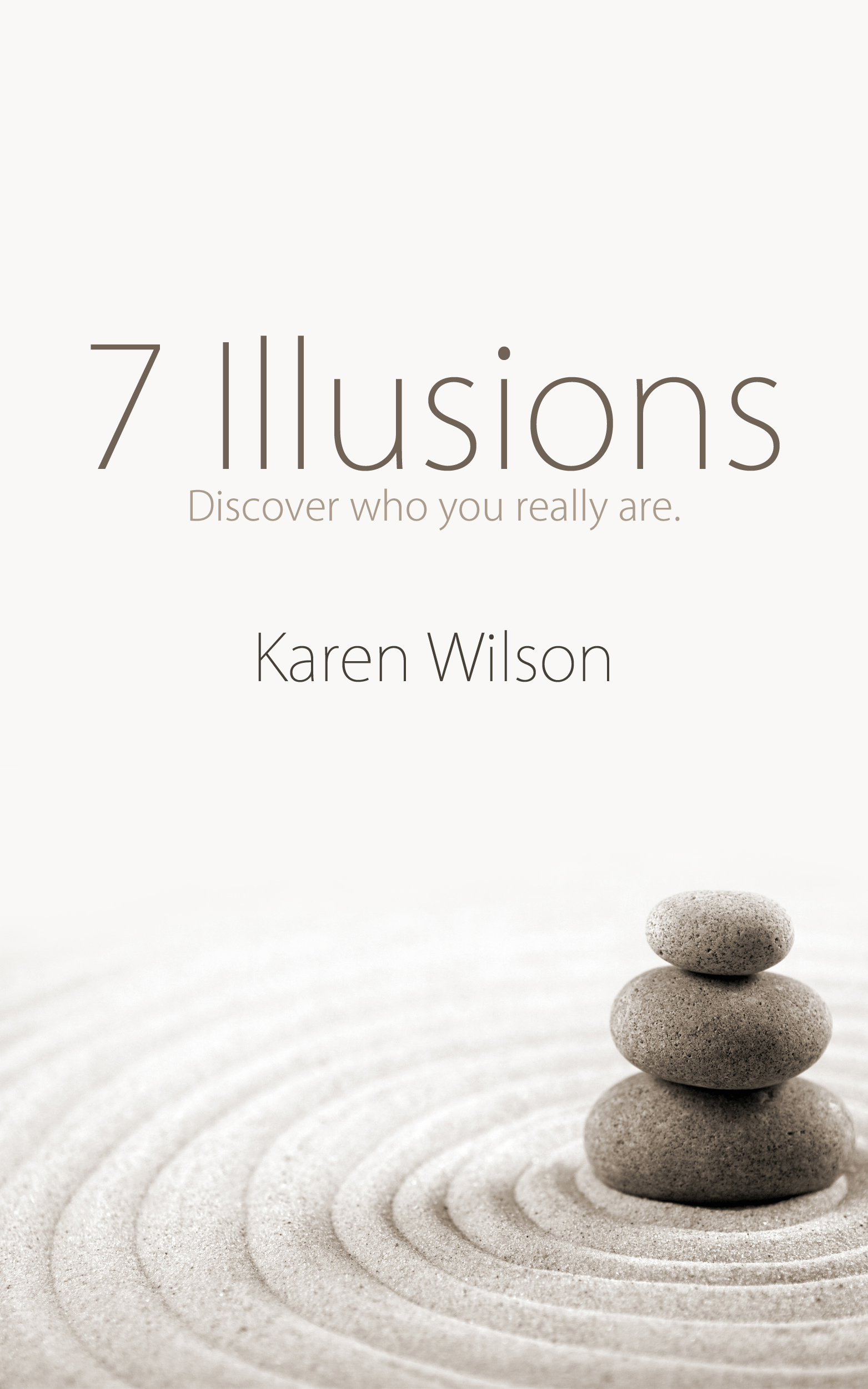
I recently finished reading a book by healer and spiritual teacher, Karen Wilson. Karen has spent the last decade or so immersed in the study of spirituality, meditation, and alternative health. No stranger to the mystical, she shares her experiences and the techniques you can use to find happiness, inner peace, and contentment in her newly released book titled, 7 Illusions. Karen teaches at workshops and spiritual retreats in Australia and Europe.

7 Illusions asks us to examine who we really are. The seven illusions she explores are categorized as creation, free will, the mind, fear, death, the self, and emotion. Understanding how our perceptions cloud our reality opens our eyes and allows us to see things as they truly are. This is the key understanding that will allow us to live happy, contented lives. Karen writes from experience and is passionate about helping others as we make the spiritual journey. She joins me today to discuss her book and her approach to spirituality.

Welcome to the blog and thanks for taking the time to be with us. I appreciate it!

IMG_4156

What do you think triggered your spiritual journey? What were your own personal challenges at the time?

When I arrived in Australia at 23, I wasn’t at all into anything ‘spiritual’. During my travels I arrived ‘by chance’ in a little town called Byron Bay, the alternative mecca of Australia. There I started hearing about all kinds of New Age beliefs, alternative therapies, talks about yoga-healthy living- meditation, and God. I remember thinking that all these people might be crazy or that there was something they knew that I didn’t. I started asking questions to ‘the universe out there’ as I was being told. I wasn’t expecting any answers back, at all. Yet I got some. Too many to be ignored, I couldn’t keep my head buried in the sand anymore. That was my biggest challenge, to realize that all my old beliefs were not true, that was questioning my very sense of self. I was like an adult back at kindergarten, having to learn everything from the beginning. When I was ready to learn, I started reading all kinds of self-help / New Age books. I started learning energy healing, and I started meditation. All that I didn’t believe in before! I practiced a lot and I also started having many ‘spiritual/mystical’ experiences. My life totally changed in the years following these awakenings. I became happier, more peaceful. I also healed my physical body. I was on medication for hypothyroidism since I was 14, which according to my doctor couldn’t be cured. But the best of all, I found myself and I started living, really living.

Your book identifies 7 illusions. Of these, which is the most difficult to overcome or see through?

I think the identification with the mind is a powerful illusion. Until we experience a state of no mind and realize that we are not that voice in our head, the mind will keep on controlling us. The mind is a great tool, but it is not who we are. Unfortunately we tend to get caught in its incessant chatter without realizing that we have the power to stop it or change ‘what is being said’. If we change ‘what is being said’, then we change the experience we are living. No matter what`s in front of us, the mind will always judge it. Things are either ‘good’ or ‘bad’. The difference between the two comes from the programming of our mind. But seeing things as ‘good’ will create a sense of happiness while ‘bad’ will bring dissatisfaction. That`s the difference between an optimist and a pessimist. When we identify with the mind we are condemned to see life through its filter. But when we understand that we are not that mind and that we have the power to change the filter, then our life changes. We truly have the power to change our mind and our life.

Photo by: Kate Jewell

Photo by: Kate Jewell

I love the phrase from the book about “creating happiness by creating ourselves happy.” How can we go about this?

We can create ourselves happy by changing our negative beliefs and perceptions on life and on ourselves. We will never find happiness on the outside; we will never find happiness in material things. All the happiness in the world is present inside of us. What does it mean to be happy? It is being contented with what is. It is being contented with who we are. If we want to create ourselves happy, we can create the person we will be contented with. The person we dream of becoming. And there is an indefinite number of possibilities of who we can be. For example, are we trying to become rich to feel more empowered and self-confident? Then why not trying to be more confident first, so it doesn’t matter if we get rich or not, we will be happy with ourselves. We can create ourselves as we wish. We can be anyone we want to be. And becoming our dream-self will bring us self-love and contentment which no amount of money in the world can buy.

The book balances the idea of free will and fate. In this way, we’re not omnipotent but we’re not victims either. How do we integrate this into our daily lives?

If we can`t change what is happening right now in our life, we can always change how we are reacting to it. We can always try to fight and resist our life but it will only bring unhappiness and frustration. When we start accepting what is and when we start to live the present moment, then our experience changes. We are not changing the outside circumstances, but we are changing the inside, we are changing ourselves. Instead of focusing all of our thoughts, all of our energy on the past or on the future, we can shift our focus to the now. We can start living and enjoying the now. And in the now we have the power; we have the free will of who we want to be. In the now we can choose to be happy or not, we can choose to be fearful or not, we can choose to be loving or not. In the now we always have the choice to smile…or not.

Photo by: Deror Avi

Photo by: Deror Avi

Why do you think so many people struggle with meditation?

I think it is because we don`t learn early enough how to meditate. We are taught early how to use our body: how to walk, talk, write, use a fork, etc. Imagine if we were to start learning all that in our twenties, thirties or later, imagine the struggle then! It`s also like training a dog, it`s much easier to train a puppy than a grown up dog with its old habits and way of being. It`s the same with our mind and meditation. It does not mean that it`s too hard or impossible, just that it may take more time and effort to tame ‘the beast’. Many will give up after a few days or weeks, thinking that it doesn’t work or do anything. It’s like going to the gym after years of not exercising and looking at our abs after a week and giving up because we don’t have a six-pack yet! I remember the first time I meditated, I only lasted five minutes! My mind was so busy and ‘unchained’ that I kept on forgetting I was meditating! Yet I’m so glad I persisted, as not only it became easier and easier, but it totally changed my life. I think meditation can be a struggle at the beginning but it is definitely worth the effort.

Why is it good to be “out of your mind?

Because when we are “out of our mind” we are present, we are here. We can be physically present somewhere, yet in our mind we are somewhere else. We can be in a beautiful place in nature yet we can’t really SEE it, because we are thinking about something else. To really SEE something we need to be completely present with it. When we look at a tree for example, and start defining it: ‘it`s a nice tree’,’ it’s an oak’, ‘it’s quite tall’, we are still in our mind. We are LOOKING at the tree but we don’t really SEE it. Instead of watching the tree we are listening to the voice in our head which is telling us about the tree. Soon that voice is going to compare that tree to another, make judgments, reminds ourselves of other trees we have seen in our past, then other people, then we are going to think about what we are going to have for dinner. We are still in front of the tree, but we are long gone. If we are ‘out of our mind’ then we just look at the tree, that is all. There is nothing standing between the tree and us, no words, no thoughts. We are really seeing what is. The tree just is, and we just are, that is all.

Thanks for being here and sharing!

For more about Karen Wilson or her book, 7 Illusions, please explore these sites.

Website: www.karenwilson.co

Facebook: http://www.facebook.com/omniahealing

Blog: http://karenwilson33.wordpress.com

Amazon: http://www.amazon.com/Illusions-Discover-who-really-are-ebook/dp/B00JZHU3TM/ref=sr_1_1?ie=UTF8&qid=1407958582&sr=8-1&keywords=7+Illusions+by+Karen+Wilson

15 Comments

Filed under Book Review, Books, Buddhism, Energy medicine, healing, Spiritual/Mysticism