Author Archives: ellisnelson

ellisnelson's avatar

About ellisnelson

writer of YA (young adult) & middle grade fiction, astrologer

SHAMAN ELIZABETH Joins Me for Author Interview- Get her FREE Book Now

FREE “Shaman Stone Soup” eBook — Limited Time!

Shaman Stone Soup

Shaman Stone Soup

Shaman Stone Soup is an Enchanting Memoir Featuring 20 True-Life Stories of Miracles. It’s available free on Amazon.com during a special promotion on January 4-8 (Kindle eBook) to help promote her new release, Dreams of Dying.

In Shaman Stone Soup, Shaman Elizabeth Herrera shares personal stories of spirit guides, angels, and enlightened beings answering calls for help through miracles. You’ll read about the spirits of ancient wise men who provided a miraculous cure from cancer for a friend; Elizabeth’s vivid dream of a pastor who needed guidance and their later “chance” meeting; a client’s husband, who was visited by three spirits showing him the past, present and future; and many more!

“Unique and captivating!” — Awareness Magazine

“Clearly written from the heart.” — Sandra Ingerman

“Beautifully written and heartfelt stories.” — Hal Z Bennett

Shaman Stone Soup will take you on a journey to the mystical side of life, where miracles and healing are natural occurrences. 

FYI: the Kindle app can be downloaded to computers and smart phones.

11 Comments

Filed under Book Review, Books, Spiritual/Mysticism

WELCOME BACK FRANCIS


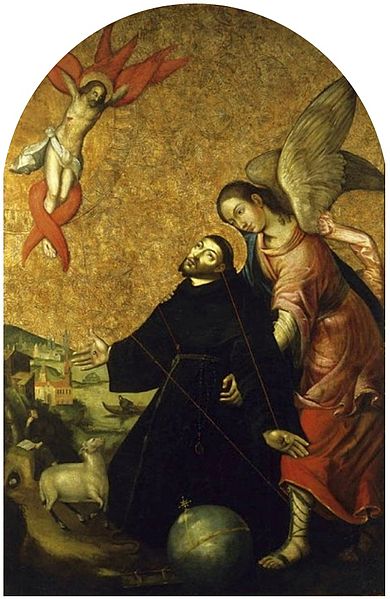
St. Francis, 13th Century

St. Francis, 13th Century

A couple of years ago I listened to one of those Great Courses lectures on St. Francis of Assisi. I patiently waited through all the talk about his early beginnings, his military experience, his illness, his rejection of society, and his eventual creation of a new order. Most of it was dry and rather matter-of-fact. Where was the meat? Where was the mystical Francis I’d heard about? Where were the stories, the hagiography, that made Francis one of the most loved and recognized saints of all time? I walked away from the lectures shaking my head in disappointment. It wasn’t until later that my reading caught up with the reality. I had been very naïve believing a history and art professor would ever broach the subject of mystical experience. It wasn’t done; even an academic degreed in comparative religion would shy away from this discussion. How sad because isn’t that what many of us hunger for?

Francis has whispered from time to time to me. A statue in someone’s garden, the visit of the Pope this fall to Assisi, a well-known spiritual teacher planning a workshop there, St. Francis hospital visible from my new house. Then recently, Pope Francis was proclaimed Time’s Man of the Year. Francis is present in ways he hasn’t been in a long time. What can a twelfth century saint have to say to the modern world? Maybe a lot.

St. Francis in Ecstasy Caravaggio, 1594

St. Francis in Ecstasy
Caravaggio, 1594

Let’s dispense with the relevant historical details (and don’t worry it won’t take twelve lectures) to seek out a deeper meaning for Francis in our time. Francis was born Giovanni di Pietro di Bernadone around 1181. Born into a wealthy merchant family, he enjoyed all the advantages of his station and even went off to war fighting for Assisi. Some kind of vision compelled him to return home where he subsequently lost his zeal for the kind of life he’d been previously living and he began to reject it. He left his father’s silk business, took to serving the poor and lepers, and gained a following. Francis eventually went on to found the Order of the Friars Minor, the Order of St. Clare, and the Third Order of St. Francis.

It was in San Damiano that Francis had a powerful mystical experience which was to frame his life’s work. While praying before an icon, he had a vision of Jesus who spoke to him and said, “…go and repair My house which, as you can see is falling into ruins.”  Francis’ interpretation resulted in him raising money to repair the physical church he was in. Of course, Francis’ mission was not a literal one and called him instead, to restore the institution of the Church.

Stigmatization of St. Francis Matthias Kargen, 1664

Stigmatization of St. Francis
Matthias Kargen, 1664

Although never ordained, Francis’ calling was manifested in a simple life of poverty emulating the life of Christ. His followers were “To follow the teaching of our Lord Jesus Christ and walk in his footsteps.” He was devoted to his spiritual practice and at times would withdraw from life to develop it. He had guiding visions throughout his life, was seen levitating, and was the first recorded person to receive the wounds of Christ (stigmata). Francis was a mystic, but he was also a mystic who brought back what he learned and shared it.

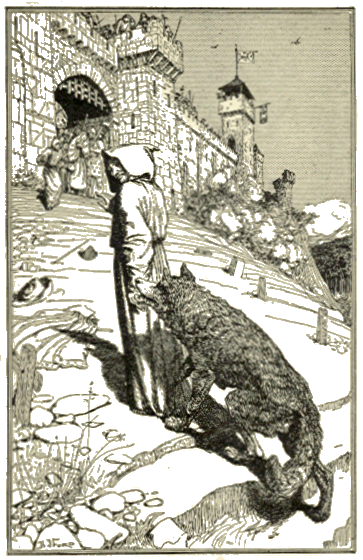
St. Francis leads the wolf of Gubbio. HJ Ford, 1912

St. Francis leads the wolf of Gubbio.
HJ Ford, 1912

Two of the most widely known miracles told about Francis involve his ability to work with animals. In the town of Gubbio, a wolf threatened the townsfolk. Francis intervened and made a pact with the wolf. Thereafter, the wolf remained peacefully near the village and the people fed it. The other story concerns an incident where Francis was trying to preach over the noisy chatter of swallows. He asked the birds to be silent and to the amazement of the crowd, they did. That famous story is the reason why Francis statues and art depictions often have a bird. Francis is the patron saint of animals and the environment.

As we draw near to Christmas and many churches display a nativity scene (Francis is credited with creating the first nativity scene), I hope you will remember a simple saint who lived an exemplary life devoted to poverty and service. His mystical connection to the Universe (God, if you prefer) was the powerhouse of his practice.

For More:

Canticle of the Sun: http://en.wikipedia.org/wiki/Canticle_of_the_Sun

St. Francis Peace Prayer: http://en.wikipedia.org/wiki/Prayer_of_Saint_Francis

Book: The Life and Prayers of St. Francis

44 Comments

Filed under animals, Book Review, Books, Spiritual/Mysticism

PHILIP K DICK: MYSTIC

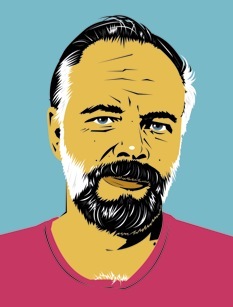
Philip K. Dick Portrait by Pete Welsch Washington, DC

Philip K. Dick
Portrait by Pete Welsch
Washington, DC

Most people know Philip K. Dick (PKD) by way of two main venues- either his science fiction novels or his movies (Minority Report, Blade Runner, etc). If fact, he is more famous now then he ever was in life. Such is the nature of being a visionary- the art world is rife with this. The thing I find fascinating about PKD though, is something most people have never heard about. PKD had many mystical experiences and he wrote about them.

His first encounter happened in Feb. 1974 and what followed would direct a line of inquiry for the rest of his life. After oral surgery and under the influence of sodium pentothal, he opened his door to a delivery girl who was wearing a gold necklace with a pendant in the shape of a fish- an early Christian symbol. The sun glinted off the fish producing a pink beam. The resulting mystical experience involved an encounter with an intelligence which allowed PKD to receive wisdom and clairvoyant messages. Throughout Feb. and Mar., the experiences continued with visions and more encounters. At one point while in trance, PKD received detailed medical information about his son and a life-threatening condition. Rushing the baby to the hospital, doctors indeed confirmed the condition and saved the boy.

exegesis

In the years of exploration and searching that followed, PKD kept detailed journals, totaling some 9000 pages. Whittled down to 900 pages, Exegesis is a collection of his mystical experiences and the author’s attempts to make sense of what was happening to him. It makes for fascinating reading. There is real passion and honesty in his efforts to understand and deal with what was going on. On one hand, it’s very inspiring but on the other, it’s unsatisfying too. PKD never really accepts any one answer and scholars who view the material are also at a loss. What really happened to PKD during the period known as 2-3-74 (and after) and what did it mean?

PKD’s last novel was entitled The Transmigration of Timothy Archer. It is considered to be one of his best, and truly, it is a metaphysical work. Reading Exegesis and then Transmigration, the reader is encouraged to search for their own answers and fully engage the mind. Happy reading!

29 Comments

Filed under Spiritual/Mysticism

WHAT IF YOU DON’T HAVE TO DIE TO FIND OUT?

    THE TIBETAN BOOK OF THE DEAD

Tibetan Book of the Dead

In 1927 American anthropologist, Walter Evans-Wentz published a bestseller he called The Tibetan Book of the Dead taking his lead from the Edwardian fascination with all things Egyptian. Only five years earlier Howard Carter had discovered King Tut’s tomb. Evans- Wentz’s book or subsequent translations can be found in most bookstores and the original has never gone out of print. During the rebellious Hippie days, the book was re-interpreted by Timothy Leary at Harvard to guide and justify the use of LSD. How can an eighth century Buddhist text still capture our imagination? Simple really. It might just hold the key to what happens after death.

Lama Kazi Dawa Samdup & Walter Evans-Wentz, circa 1919

Lama Kazi Dawa Samdup & Walter Evans-Wentz, circa 1919

Not that this book will ever really be mainstream. How could it be in a society perpetually captivated by youth and the denial of death? Americans do not talk about death. It is taboo. People die in hospitals and nursing homes, and we like it that way. As a society, we are all about acquiring stuff and death has its upside. Maybe we’ll inherit something. That’s probably about as deep as it goes. We muddle through funerals and try very hard to get back to normal. It is the odd fellow who contemplates his own death. So if you are a typical American, this is where you go look for something ego-comforting and fluffy elsewhere on the web.

Ah, but what if you’re not typical. Come closer because we are about to examine the origin of a mysterious text and answer some questions about what happens to you when you die.

PADMASAMBHAVA, wall painting in Bhutan, Baldiri, 2007

PADMASAMBHAVA, wall painting in Bhutan, Baldiri, 2007

Sometime in the eighth century the famous Indian saint, Padmasambhava entered Tibet. Today he is known for converting the indigenous demonic spirits of Tibet to Buddhism, doing healings, and producing miracles. He also wrote a funerary text which he called Liberation Through Hearing During the Intermediate State. Some scholars have called it the first how-to book, but today we  know it as The Tibetan Book of the Dead. Upon reflection, Padmasambhava felt he couldn’t release the book to a population of newly created Buddhists. He hid the book keeping it safe for future generations. Six hundred years later, treasure revealer (terton), Karma Lingpa had a vision and was able to recover the manuscript.

The book is a guide for what happens to your consciousness as it passes from this life to the next. Reading it before death allows for preparation and familiarization with the process.

For, at this singular opportunity, you could

attain the everlasting bliss (of nirvana).

     So now is (certainly) not the time to sit idly,

     But, starting with (the reflection on) death, you

should bring your practice to completion.

In Tibet, the text is read for the dead by monks during a forty-nine day transition period. After encountering the light (similar to what NDE survivors report), the deceased is faced with three bardo states. Each phase offers the opportunity for liberation (enlightenment). Rare individuals who have been well-prepared avoid subsequent phases having mastered the understanding of consciousness, avoid rebirth, and become enlightened. Others pass through the bardo stages where various peaceful and terrifying beings appear arriving at the third which concerns itself with rebirth. A person’s karma then directs rebirth into one of six realms. The human realm (although not the most comfortable) is considered to be the best because it offers the possibility of eventual enlightenment. The deceased has the ability to choose his parents and the best situation for the next incarnation.

Zhi Khro Bardo Thodol: Mandala associated with The Tibetan Book of the Dead

Zhi Khro Bardo Thodol: Mandala associated with The Tibetan Book of the Dead

The value of The Tibetan Book of the Dead does not lie in its vivid descriptions of the entities the deceased meets along the way because those can be viewed as cultural constructions. Interestingly enough though, it might explain why Christians meet Jesus or Muslims meet Mohammed as reported in near-death accounts. The bardos are constructions of the mind, self-generated, and culturally dependent. You can only create what you are familiar with and what scares you the most. So the value of this profound and lyrical text is an overall familiarization with the process of death as a transition of consciousness. From the Tibetan standpoint, death doesn’t have to be a scary unknown. It is knowable and everyone can prepare for it. What would it be like to live a life not fearing death? How would our world change?

Watch a History Channel Documentary on The Tibetan Book of the Dead:

                              http://www.youtube.com/watch?v=Ermcc6iDqQA

FOR MORE:

The Tibetan Book of the Dead

Pilgrims of the Clear Light- Biography of Walter Evans-Wentz by Ken Winkler

58 Comments

Filed under Book Review, Buddhism

INTERVIEW WITH NAOMI C. ROSE, AUTHOR OF:

WHERE SNOW LEOPARD PROWLS

Tibetan Wildlife Cover.2.indd

This is my first author interview and it seems fitting to welcome Naomi as my first guest. We met several years ago when I was first working on Into the Land of Snows. Naomi was a children’s author/illustrator who had already published a book on Tibetan culture and I sought her out for guidance. She graciously supplied it. I am happy to welcome her here to talk about her fourth picture book entitled Where Snow Leopard Prowls.

Thanks, I’m very honored to be your first interviewed author!!

NaomiRose

Naomi, your first three picture books dealt with Tibetan culture and Where Snow Leopard Prowls marks a change for you. This book is all about wildlife on the Tibetan plateau. Can you talk about how your vision shifted and you were drawn to paint these images?

I’ve had the joy of creating books for children for many years. Two of my previously published books are wisdom tales from Tibet. Several years ago, while painting the illustrations for these books, I found myself painting more and more Tibetan wildlife into the scenes. And as I painted, I felt more and more endeared to these animals. When I finally painted a snow leopard, I knew the animals were calling me. It was time to create a book for and about them. 

I’ve always thought of picture books as a child’s first introduction to art. The time and care that goes into the production of a picture book is amazing. How long was it from the time you decided to write and illustrate this book until you held it in your hands? What was the process like?

I think it was about five years from conception to birth. I really try to give each book the time it needs, to let the inspiration, the art, the book itself lead the way. When I first felt the call to do a book on Tibetan wildlife, I envisioned an activity book. But when I had completed that, I realized there was something more wanting to emerge. So I switched gears and created a full 32-page picture book. Then I posted the activity book as a free companion book off my website.

Baby Leopard

The paintings also evolved in an interesting way. I painted Snow Leopard’s portrait first. To my surprise, I felt very compelled to paint Snow Leopard’s eyes before any other feature. This was NOT how I was taught to paint portraits, but I couldn’t resist the urge. Once the eyes were painted, it felt like Snow Leopard was watching me paint, and guiding me on various details of its portrait. This turned out to be the case with each portrait, culminating in a deeper connection with each animal. 

Some of the animals in the book readers may be familiar with but there are some that were new for me. I’d never heard of a Himalayan Tahr, for example. Was there an animal you researched that was totally new to you? I know the book is full of animal facts and I wonder if there is anything in your research that surprised or even shocked you.

Many of the animals were new to me. Himalayan Tahr is a good example. I don’t remember what drew me to this particular animal, but somehow Tahr popped out at me as I studied the animals and the land of Tibet. Once Tahr showed up on my radar, I had to paint it and give it a place in the book. That’s sort of how it went. I think the animals found me as much as I found them. I had great fun learning about them and finding fun tidbits to put in the book. They’re all so amazing!  These animals became so personal to me that I had to treat them as individuals, thus referring to them by name (“Snow Leopard” instead of “a snow leopard”).

You’ve talked about the importance of having children connect with wildlife. It is in that connection and caring that we may be able to do a better job protecting whole environments. Can you outline a few of the factors that threaten some of the species in your book?

That’s a really interesting question because I ended up choosing to not study those factors.  When I first worked on the book, I focused on how these amazing animals were at risk of extinction as a way to motivate children to care for Mother Earth. Then I realized that approach wasn’t right for me.  I wanted to motivate from the same place that motivated me to do the book, a growing personal connection. I believe that’s another way to motivate; by fostering a love, respect, and connection with wildlife and nature, children will naturally grow to care about Mother Earth and her precious animals. In hopes the book has motivated children to care, I’ve listed things we can do to help in the back of the book. I’ve also listed activities for cultivating a personal connection to the natural world. 

Baby Monkey

My favorite illustrations were the baby snow leopard and the red panda. What animal or animals were the most fun for you to paint and why?

I loved painting them all, of course. But I had a special fondness for the baby animals. They are all soooo cute!  And painting Mama Snow Leopard was especially powerful.  I invite folks to see more of the animals in the short video on my website:  http://www.naomicrose.com/books/wslp-books

Thanks, Naomi for sharing your wonderful book with us. Please visit Naomi’s sites to see more of her beautiful work.

Website link(s):  http://www.naomicrose.com

Facebook:  www.facebook.com/naomicrose

Youtube: www.youtube.com/user/naomicrose

21 Comments

Filed under Book Review, Books

HER STROKE OF INSIGHT

Thirty seven year old neuroanatomist, Jill Bolte Taylor, rose on the morning of Dec. 10, 1996 to start her morning routine getting ready for work. It turned out to be anything but routine.

 A blood vessel exploded in her left hemisphere leaving her unable to walk, talk, read, or write.

To understand what she experienced, it’s important to recognize how the two parts of the brain work. The right hemisphere thinks in pictures and connects us all as “energy beings” as Jill describes it. The right brain is all about being in the moment and sees us as perfect and whole. The left hemisphere thinks linearly, connecting us to past and future. It thinks and plans using language. It is the left hemisphere that creates the experience of the self as separate from everything else.

JB Taylor

Jill woke that morning with an intense pain behind her left eye. Not realizing anything was truly wrong, she attempted to get on with her day and proceeded to her cardio-glider to get her exercise done. On the machine, she noticed that her hands looked like strange claws. Then she had the experience of witnessing her body as if it were a separate entity. Her head pain intensified so she got off the machine. It was then that everything seemed to slow down. Gone were her quick and fluid body movements. The rigid boundaries of her body evaporated as she propped herself against a bathroom wall. She watched as the molecules and atoms of her body merged with those of the wall. Next she lost her left brain chatter as her mind was silenced.

In the quiet, Jill was drawn into an expansive field of oneness. This was a peaceful, delightful place until the left brain returned telling her she had a problem and needed help. She would alternate between these two realities: one she called La-La Land which was a beautiful state of pure consciousness and connectedness and the other that called her back into the world with ever-increasing urgency. When her right arm became paralyzed, Jill realized she was having a stroke. She knew she needed help and attempted to call work. But by this time, she had lost the ability to recognize words and numbers and it took 45 minutes to finally make this all important call.

At the hospital, Jill struggled with the pain and sensory overload of being in the body. Those experiences were relieved at times by journeys into nirvana (her word); that profound place of peace, freedom, and expansiveness. On a deeper level she comes to understand that everyone can experience this nirvana state.

     “That they could purposely choose to step to the right of their left hemisphere and find this peace.”

This is her stroke of insight, the gift she brought back into the world, the source that would motivate her  year long recovery.

We have the choice to move between the hemispheres moment by moment. We choose, we create. Jill believes (and I agree) the more time we spend in the right hemisphere, the more peace we will find as individuals and the more peace we will bring back into the world.

Jill Bolte Taylor has written a wonderful book. It will especially appeal to the scientifically minded, but it will attract just as many mystics. The other true gift of her experience has to do with understanding what it’s like to have a stroke. If the medical community and family members had this level of understanding, it would revolutionize the care we give stroke victims. I would especially recommend her book to anyone who is caring for someone who has had a stroke. To learn from the inside out what it’s like can only make us more compassionate and more understanding.

WATCH DR. TAYLOR AT TED:

60 Comments

Filed under Book Review, Energy medicine, Spiritual/Mysticism

WHO WANTS TO BE NORMAL ANYWAY?

“The trembling in academic journals over how science must be falling apart because of positive evidence for psi is a desperate attempt to maintain a stable worldview where psi can’t exist.” Dean Radin, PhD

Welcome back old and new friends. It’s been a while and I wanted to share something I’m really enjoying. I’m reading Supernormal by Dean Radin. From the mystical side I’ve known that many (if not all) spiritual traditions hold that spiritual progress, especially through meditation practice, directly leads to the emergence of what we commonly call psychic ability (PSI). And these traditions also warn the seeker not to be distracted or side-lined when it happens because the spiritual path’s goal is Truth or union with the Universe (God, divine, Absolute, Reality, etc.). Leave it to scientist Dean Radin to put this to the test.

51jTUbPpTYL__BO2,204,203,200_PIsitb-sticker-arrow-click,TopRight,35,-76_AA300_SH20_OU01_

About two thousand years ago, Pantanjali (The Yoga Sutras) wrote in rather cookbook terms that if you sit down and quiet the mind and dedicate yourself to this practice, you will eventually gain supernormal powers (siddhis). Elementary siddhis as outlined by the text include telepathy, clairvoyance, precognition, and psychokinesis. And to open your mind further, Pantanjali goes on to discuss the more advanced siddhis of invisibility, levitation, invulnerability, and superstrength (homage to comic book superheroes here). Are you still with me or are you rolling your eyes and scoffing? I sense a few of you are… smiling.

If you’ve read some of my previous work, you already know that science long ago established the existence of precognition with the Rhine experiments and the meta- analysis which followed (Honorton/Ferrari). There is statistically significant evidence for precognition although its effect is small in the general population. The point is that it’s there.

In the 1990s Radin went on to look at presentiment (prefeeling instead of preknowing). Radin used a random number generator and a stock of color photos which contained calming or emotional images that were flashed on a computer screen. He collected the subject’s reaction via skin conductance levels using electrodes attached to the palm. (Radin gives an exhaustive description in the book in case anyone wants to examine all the experimental protocols.) The results indicate that people react physiologically BEFORE they see the image on the screen. The experiment is strong evidence for presentiment even though the subject does not have conscious awareness of the image.

Back to Pantanjali. In a fairly complicated experiment, Radin looked at a group of meditators and non-meditators (sixteen individuals total). Meditators with a lot of experience in non-dual techniques often can achieve a deep state of absorption (Samadhi/Samyama) where time and space evaporate. The yogic perception is that an underlying deeper reality exists beyond time and space. In this reality, past and future influence the present. We are used to thinking about the past influencing the future, but it may also be that the future is at work as well. In this way of looking at things, presentiment/precognition can be viewed as the future influencing present awareness.

In the experiment, 32 channels of EEG were measured before, during, and after exposure to unpredictable light and sound stimuli. If meditation practice developed a way to extend consciousness through time, then we would expect the meditators to exhibit prestimulus differences in EEG responses over the control group (non-meditators). The research revealed that meditators did show brain activity that anticipated an audio signal. Non-meditators did not show any significant prestimulus differences between light v. sound.* The outcome supported the idea that the meditators were accessing the future in a way consistent with Pantanjali’s description.

A reversal of the cause-effect sequence is compatible with classical and quantum physics. Physicists already accept time reversal for the quantum world, but the evidence for precognition suggests it also takes place in the macro-world.

The evidence for precognition/presentiment may excite you or it may make you very nervous but either way, it should make you pause to consider how our worldview must change. Science has to take us to new places and challenge us to think and see in new ways. Scientific laws are not carved in stone and to reject all PSI research because it doesn’t fit a materialistic worldview only slows down the inevitable. We are starting to see the ground shift. Seventy-five years of scientific evidence from all over the world indicates that humans do possess one of the siddhis Pantanjali listed. We can glimpse the future.

More Summer Reading:
Emotional Freedom (Energy Psychology)- Judith Orloff, MD
The Biology of Belief- Bruce Lipton, PhD
The Way of the Explorer- Edgar Mitchell (astronaut)
The Genie in Your Genes- Dawson Church (epigenetics)

*Reasons why the non-mediators didn’t exhibit presentiment (in this small study) may be due to the stimulus not being emotionally charged and/or the choice of measuring physiological changes might not be the best one.

67 Comments

Filed under Book Review, Books, PSI, Spiritual/Mysticism, Uncategorized

A SHIFT

A recent series of setbacks has the blog on hiatus while I deepen my practice and look for work. Click to see WORK FOR HIRE

32 Comments

Filed under Blogging

THE CHAKRAS AND SPIRITUAL GROWTH

Chakras

I recently finished reading In Search of the Miraculous- Healing Into Consciousness by Eliza Mada Dalian. It’s a book for spiritual seekers wanting a manual on the path out of fear, pain, and suffering. This is a largely down to earth book that attempts to simplify the mystical and make it accessible to the average reader. It is not St. Theresa of Avila, The Cloud of Unknowing, a Buddhist sutra, or a Sufi text. Dalian grounds her work and for that we can be thankful.

The one section I found to be particularly useful was the part concerning the development of the ego-mind in each of the chakras. Chakras can be thought of as circular energy centers, and for our purposes, we will use the traditional Indian system of seven chakras. Dalian is careful to point out that spiritual development through the chakras is not necessarily a linear one. I take that to mean that life’s trials and tribulations can have us working in any chakra at any time or in several (which seems likely given the complexity of life). Let’s take a look at the spiritual work associated with each chakra and see if you can identify where you are in the process.

Healing Into Consciousness

1st Chakra (Root): Foundations of Life: (located at the base of the spine)
Although some writings on chakras are different, Dalian identifies this chakra as the center for sexuality. The spiritual work here involves breaking through sexual fears, taboos, and conditioning.

2nd Chakra (Hara): Survival of the Physical Body: (located 2” below navel)
Here the spiritual seeker deals with fears or insecurities over your physical survival. Eventually you develop trust that the universe will take care of you.

3rd Chakra (Solar Plexus): Developing Self Power & Decision Making Ability: (located in solar plexus region)
Spiritual work here involves developing the courage to make decisions, set boundaries for protection, and accept the responsibility for one’s actions. Considerable maturing of the ego-mind happens here.

4th Chakra (Heart): Developing Unconditional Love: (located behind the sternum near the heart)
The heart chakra is the bridge between the lower instinctual chakras and the higher spiritual chakras. Dalian believes that 90 percent of humanity is stuck in the first three chakras and I’d tend to agree. The work of the spirit in the 4th chakra is to transform the body’s need for survival and the instinctual lust of self- gratification into unconditional love.

5th Chakra (Throat): Developing Individuality & Self Expression: (located at the base of the throat near the thyroid) The spiritual challenge here is to develop honesty and integrity that allows an individual to break free of old patterns, beliefs, and social conditioning to bring freedom of expression and individuality into the world. There is a turn inward for truth and compromising the soul is no longer possible. People begin to speak and live their purpose.

6th Chakra (Third Eye): Developing Wisdom & Intelligence: (located in the center of the forehead between the eyebrows)
Spiritual growth in the 6th chakra is associated with the revelation and expansion of psychic knowing. Sometimes called the opening of the third eye, the door to cosmic reality opens. An individual begins to develop extra-sensory abilities, intuition, and begins to glimpse who he/she really is in cosmic terms. Interconnectedness becomes apparent.

7th Chakra (Crown): Dissolving the Ego: (located at the top of the head, acts as the transition point between physical reality and cosmic reality)
This is what Buddhists call Enlightenment. It’s the ultimate goal, the end game. Here, spiritual work involves the death of the ego-mind and ultimate liberation. Through the 7th chakra, the life force moves from time/space reality into timeless reality of ever-evolving consciousness. It’s important to remember that enlightenment (or liberation) is available at every moment of life or at the point of physical death.

If you’d like to learn more about any of the specific challenges associated with the chakras or techniques and meditations that may be useful, grab a copy of the book. There is a whole chapter packed with resources to help. You can also visit the author’s website at www.madadalian.com.

77 Comments

Filed under Books, Spiritual/Mysticism

FUN WITH NEW WORDS

The origin of English words.

The origin of English words.

I just want to remind all my tweeps to refrain from photobombing me unless you want my ripped OH to set a micropig lose on you during one of your date nights.

It sounds ridiculous, and it is, but how many of you recognized six new additions to the online Oxford Dictionary? After all, language is an evolving art form and 2013 saw some interesting additions to the grand old tome. Usually by the time slang is incorporated into something as old and wise as the dictionary, many of us are already using the words or have heard them in some context. Old and wise as the dictionary? Dictionaries have been around forever, right? Not so fast.

The Oxford English Dictionary really isn’t as ancient and definitive (yes- a pun!!) as you might think. It wasn’t until 1857 that the Philological Society of London got together and started to think about putting together a dictionary of the English Language. After five years of hard work, the authors had reached the word “ant” and realized the project was going to take much longer than the planned ten years. Published in multiple volumes, The Oxford English Dictionary (affectionately known as the “OED”), was finally completed in 1928. If you want to read more about this Herculean task, Simon Winchester’s book, The Professor and The Madman: A Tale of Murder, Insanity, and the Making of the OED is a great read.

51OED

Language is all about communication and for us to understand each other in the ever evolving reality of today’s world, we have to keep up with the ways in which science, technology, entertainment, and social media change things. These are the areas that probably contribute most of the new words. Gone are the days when writers like Shakespeare created his own words and Lewis Carroll coined vorpal, chortle, galumph, and burble. But maybe not. New words are added every year and they have to come from somewhere. Maybe you will come up with the next slick phrase for something. In the meantime, let’s take a look at a few of the new entries for 2013.

OED Online Additions:

tweeps– (n.) your followers on Twitter

photobomb-(v.) to ruin a photograph by suddenly appearing in the camera’s field of view

as the photo is taken, usually as a prank or joke

OH- (n.) a person’s wife, husband, or partner (“Other Half”, I suppose)

Micropig– (n.) a very small pig usually kept as a pet (I’ve written a book about micro-

elephants as pets and, I firmly believe with this OED addition, it’s time for the book to

be published!!)

ripped-(adj) muscular body

date night & group hug– also made it in

Merriam Webster Additions:

flexitarian– (n.) someone whose meatless diet occasionally contains meat/fish

sexting– (v.) the sending of explicit messages or photos by cellphone

Other catchy additions: game changer, brain cramp, f-bomb, bucket list, aha moment, man cave, energy drink, cloud computing, craft beer  

I’m off to look up cloud computing!


74 Comments

Filed under Book Review, Books