Tag Archives: Ellis Nelson

WHO WANTS TO BE NORMAL ANYWAY?

“The trembling in academic journals over how science must be falling apart because of positive evidence for psi is a desperate attempt to maintain a stable worldview where psi can’t exist.” Dean Radin, PhD

Welcome back old and new friends. It’s been a while and I wanted to share something I’m really enjoying. I’m reading Supernormal by Dean Radin. From the mystical side I’ve known that many (if not all) spiritual traditions hold that spiritual progress, especially through meditation practice, directly leads to the emergence of what we commonly call psychic ability (PSI). And these traditions also warn the seeker not to be distracted or side-lined when it happens because the spiritual path’s goal is Truth or union with the Universe (God, divine, Absolute, Reality, etc.). Leave it to scientist Dean Radin to put this to the test.

51jTUbPpTYL__BO2,204,203,200_PIsitb-sticker-arrow-click,TopRight,35,-76_AA300_SH20_OU01_

About two thousand years ago, Pantanjali (The Yoga Sutras) wrote in rather cookbook terms that if you sit down and quiet the mind and dedicate yourself to this practice, you will eventually gain supernormal powers (siddhis). Elementary siddhis as outlined by the text include telepathy, clairvoyance, precognition, and psychokinesis. And to open your mind further, Pantanjali goes on to discuss the more advanced siddhis of invisibility, levitation, invulnerability, and superstrength (homage to comic book superheroes here). Are you still with me or are you rolling your eyes and scoffing? I sense a few of you are… smiling.

If you’ve read some of my previous work, you already know that science long ago established the existence of precognition with the Rhine experiments and the meta- analysis which followed (Honorton/Ferrari). There is statistically significant evidence for precognition although its effect is small in the general population. The point is that it’s there.

In the 1990s Radin went on to look at presentiment (prefeeling instead of preknowing). Radin used a random number generator and a stock of color photos which contained calming or emotional images that were flashed on a computer screen. He collected the subject’s reaction via skin conductance levels using electrodes attached to the palm. (Radin gives an exhaustive description in the book in case anyone wants to examine all the experimental protocols.) The results indicate that people react physiologically BEFORE they see the image on the screen. The experiment is strong evidence for presentiment even though the subject does not have conscious awareness of the image.

Back to Pantanjali. In a fairly complicated experiment, Radin looked at a group of meditators and non-meditators (sixteen individuals total). Meditators with a lot of experience in non-dual techniques often can achieve a deep state of absorption (Samadhi/Samyama) where time and space evaporate. The yogic perception is that an underlying deeper reality exists beyond time and space. In this reality, past and future influence the present. We are used to thinking about the past influencing the future, but it may also be that the future is at work as well. In this way of looking at things, presentiment/precognition can be viewed as the future influencing present awareness.

In the experiment, 32 channels of EEG were measured before, during, and after exposure to unpredictable light and sound stimuli. If meditation practice developed a way to extend consciousness through time, then we would expect the meditators to exhibit prestimulus differences in EEG responses over the control group (non-meditators). The research revealed that meditators did show brain activity that anticipated an audio signal. Non-meditators did not show any significant prestimulus differences between light v. sound.* The outcome supported the idea that the meditators were accessing the future in a way consistent with Pantanjali’s description.

A reversal of the cause-effect sequence is compatible with classical and quantum physics. Physicists already accept time reversal for the quantum world, but the evidence for precognition suggests it also takes place in the macro-world.

The evidence for precognition/presentiment may excite you or it may make you very nervous but either way, it should make you pause to consider how our worldview must change. Science has to take us to new places and challenge us to think and see in new ways. Scientific laws are not carved in stone and to reject all PSI research because it doesn’t fit a materialistic worldview only slows down the inevitable. We are starting to see the ground shift. Seventy-five years of scientific evidence from all over the world indicates that humans do possess one of the siddhis Pantanjali listed. We can glimpse the future.

More Summer Reading:
Emotional Freedom (Energy Psychology)- Judith Orloff, MD
The Biology of Belief- Bruce Lipton, PhD
The Way of the Explorer- Edgar Mitchell (astronaut)
The Genie in Your Genes- Dawson Church (epigenetics)

*Reasons why the non-mediators didn’t exhibit presentiment (in this small study) may be due to the stimulus not being emotionally charged and/or the choice of measuring physiological changes might not be the best one.

67 Comments

Filed under Book Review, Books, PSI, Spiritual/Mysticism, Uncategorized

THE CHAKRAS AND SPIRITUAL GROWTH

Chakras

I recently finished reading In Search of the Miraculous- Healing Into Consciousness by Eliza Mada Dalian. It’s a book for spiritual seekers wanting a manual on the path out of fear, pain, and suffering. This is a largely down to earth book that attempts to simplify the mystical and make it accessible to the average reader. It is not St. Theresa of Avila, The Cloud of Unknowing, a Buddhist sutra, or a Sufi text. Dalian grounds her work and for that we can be thankful.

The one section I found to be particularly useful was the part concerning the development of the ego-mind in each of the chakras. Chakras can be thought of as circular energy centers, and for our purposes, we will use the traditional Indian system of seven chakras. Dalian is careful to point out that spiritual development through the chakras is not necessarily a linear one. I take that to mean that life’s trials and tribulations can have us working in any chakra at any time or in several (which seems likely given the complexity of life). Let’s take a look at the spiritual work associated with each chakra and see if you can identify where you are in the process.

Healing Into Consciousness

1st Chakra (Root): Foundations of Life: (located at the base of the spine)
Although some writings on chakras are different, Dalian identifies this chakra as the center for sexuality. The spiritual work here involves breaking through sexual fears, taboos, and conditioning.

2nd Chakra (Hara): Survival of the Physical Body: (located 2” below navel)
Here the spiritual seeker deals with fears or insecurities over your physical survival. Eventually you develop trust that the universe will take care of you.

3rd Chakra (Solar Plexus): Developing Self Power & Decision Making Ability: (located in solar plexus region)
Spiritual work here involves developing the courage to make decisions, set boundaries for protection, and accept the responsibility for one’s actions. Considerable maturing of the ego-mind happens here.

4th Chakra (Heart): Developing Unconditional Love: (located behind the sternum near the heart)
The heart chakra is the bridge between the lower instinctual chakras and the higher spiritual chakras. Dalian believes that 90 percent of humanity is stuck in the first three chakras and I’d tend to agree. The work of the spirit in the 4th chakra is to transform the body’s need for survival and the instinctual lust of self- gratification into unconditional love.

5th Chakra (Throat): Developing Individuality & Self Expression: (located at the base of the throat near the thyroid) The spiritual challenge here is to develop honesty and integrity that allows an individual to break free of old patterns, beliefs, and social conditioning to bring freedom of expression and individuality into the world. There is a turn inward for truth and compromising the soul is no longer possible. People begin to speak and live their purpose.

6th Chakra (Third Eye): Developing Wisdom & Intelligence: (located in the center of the forehead between the eyebrows)
Spiritual growth in the 6th chakra is associated with the revelation and expansion of psychic knowing. Sometimes called the opening of the third eye, the door to cosmic reality opens. An individual begins to develop extra-sensory abilities, intuition, and begins to glimpse who he/she really is in cosmic terms. Interconnectedness becomes apparent.

7th Chakra (Crown): Dissolving the Ego: (located at the top of the head, acts as the transition point between physical reality and cosmic reality)
This is what Buddhists call Enlightenment. It’s the ultimate goal, the end game. Here, spiritual work involves the death of the ego-mind and ultimate liberation. Through the 7th chakra, the life force moves from time/space reality into timeless reality of ever-evolving consciousness. It’s important to remember that enlightenment (or liberation) is available at every moment of life or at the point of physical death.

If you’d like to learn more about any of the specific challenges associated with the chakras or techniques and meditations that may be useful, grab a copy of the book. There is a whole chapter packed with resources to help. You can also visit the author’s website at www.madadalian.com.

77 Comments

Filed under Books, Spiritual/Mysticism

FUN WITH NEW WORDS

The origin of English words.

The origin of English words.

I just want to remind all my tweeps to refrain from photobombing me unless you want my ripped OH to set a micropig lose on you during one of your date nights.

It sounds ridiculous, and it is, but how many of you recognized six new additions to the online Oxford Dictionary? After all, language is an evolving art form and 2013 saw some interesting additions to the grand old tome. Usually by the time slang is incorporated into something as old and wise as the dictionary, many of us are already using the words or have heard them in some context. Old and wise as the dictionary? Dictionaries have been around forever, right? Not so fast.

The Oxford English Dictionary really isn’t as ancient and definitive (yes- a pun!!) as you might think. It wasn’t until 1857 that the Philological Society of London got together and started to think about putting together a dictionary of the English Language. After five years of hard work, the authors had reached the word “ant” and realized the project was going to take much longer than the planned ten years. Published in multiple volumes, The Oxford English Dictionary (affectionately known as the “OED”), was finally completed in 1928. If you want to read more about this Herculean task, Simon Winchester’s book, The Professor and The Madman: A Tale of Murder, Insanity, and the Making of the OED is a great read.

51OED

Language is all about communication and for us to understand each other in the ever evolving reality of today’s world, we have to keep up with the ways in which science, technology, entertainment, and social media change things. These are the areas that probably contribute most of the new words. Gone are the days when writers like Shakespeare created his own words and Lewis Carroll coined vorpal, chortle, galumph, and burble. But maybe not. New words are added every year and they have to come from somewhere. Maybe you will come up with the next slick phrase for something. In the meantime, let’s take a look at a few of the new entries for 2013.

OED Online Additions:

tweeps– (n.) your followers on Twitter

photobomb-(v.) to ruin a photograph by suddenly appearing in the camera’s field of view

as the photo is taken, usually as a prank or joke

OH- (n.) a person’s wife, husband, or partner (“Other Half”, I suppose)

Micropig– (n.) a very small pig usually kept as a pet (I’ve written a book about micro-

elephants as pets and, I firmly believe with this OED addition, it’s time for the book to

be published!!)

ripped-(adj) muscular body

date night & group hug– also made it in

Merriam Webster Additions:

flexitarian– (n.) someone whose meatless diet occasionally contains meat/fish

sexting– (v.) the sending of explicit messages or photos by cellphone

Other catchy additions: game changer, brain cramp, f-bomb, bucket list, aha moment, man cave, energy drink, cloud computing, craft beer  

I’m off to look up cloud computing!


74 Comments

Filed under Book Review, Books

ENTER TO WIN FREE COPY OF INTO THE LAND OF SNOWS

IM000011.JPG

In the last couple of months, I’ve been happy to welcome many new blog readers and to celebrate I’m inviting everyone to enter to win a free, ARC (Advance Reading Copy) of Into the Land of Snows. All you have to do is leave a comment below to be entered. There are a couple of rules, though. I’m only going to be able to mail to a location in the US. Comments will close midnight (MT) on Wednesday, March 13th (2013). I will conduct a random drawing at that point and notify the winner. Enter only once. Just to have a theme, I’m requesting you comment on something about spring or summer. Here in Colorado, March is usually our snowiest month so spring often feels like it’ll never arrive. To start us off, I’ll post a comment so no one feels awkward to be the first to post.

Mar 14th: Thanks to everyone who entered. The winner is Augusta! Augusta- I’ve posted a notice on your blog but if you happen to see this first, congratulations. Please email me at himalayaspencerellis@yahoo.com. I’ll need your address to ship the book.

66 Comments

Filed under Books

Rethinking: Diagnosing Children with Developmental Disorders

child
I’ve been watching some of the TED talks that have been done over the past few years. There is no doubt that it’s becoming ever more difficult to keep up with the changing world of science and especially anything to do with healthcare. Just a couple of days ago I learned that antioxidants may not be the panacea they have been touted to be. So now I have to rethink my supplement choices and make sure my vitamins are “low dose.”

One of the most important TED talks I’ve seen concerned diagnosing children with developmental disorders and how we’re doing it all wrong. An estimated one in six children suffers from a developmental disorder including:

Mental retardation
Learning disorders (Dyslexia, speech & language disorders)
Attention disorders (ADD, ADHD)
Autism spectrum (Autism, Asperger’s)
Genetic disorders (Down & William Syndromes)
Sensory processing disorder
Epilepsy, seizures, sleep disorder

Traditionally, these disorders have been diagnosed in children by observing their behavior.

EEG 32 electrodes

In 2010, Aditi Shankardass gave a short TED talk about research she and her colleagues were doing at Harvard. Using an EEG, researchers were able to look at a child’s brain activity while awake and map the areas of activity in real time. Use of these tools leads to a precise neurological diagnosis. She goes on to explain that about 50% of those seen in the clinic diagnosed with autism, actually have brain seizures not detectable from observing behavior alone. Once these children receive appropriate anti- seizure meds, their conditions resolve.

Which leads to all kinds of questions. The latest statistic about the prevalence of autism is that it affects 1 in 88 children (1 in 54 boys: 1 in 252 girls). Does this research mean that half of autism isn’t autism, and in fact, easily treatable? What about the rest of the disorders? How many haven’t been diagnosed because observing behavior doesn’t catch the problem, and just as scary, how many are wrongly diagnosed? How many children and parents are suffering needlessly?

Dr. Shankardass ends her talk with a plea to spread the word about this non-invasive, diagnostic technique.

Watch TED talk:  http://www.ted.com/talks/aditi_shankardass_a_second_opinion_on_learning_disorders.html

Read article from MEDICAL NEWS TODAY: June 2012: New EEG Test for Autism
http://www.medicalnewstoday.com/articles/247102.php

52 Comments

Filed under health

THE UNEXPLAINED POWERS OF ANIMALS

LUKE

LUKE

In the last two weeks, my husband and I have welcomed a new dog into the family. Luke is a friendly, almost two year old, Golden Retriever who has had a rough start in life. As we are getting to know each other, I’m drawn back into the routine and wonder of dog ownership. All the while, our elderly cat, George, raises an eyebrow and wonders why he can’t live in a one cat household.


George

George

I’ve been re-reading and thoroughly enjoying Dogs That Know When Their Owners Are Coming Home (And Other Unexplained Powers of Animals) by Rupert Sheldrake. Sheldrake is a biologist with a Ph.D. from Cambridge. As a pet owner himself he wondered why the stories of pet owners were so universally ignored by scientists. He felt that confining research to lab animals or wildlife observation misses entirely to capture a unique understanding man has with his companion animals. Sheldrake set out to mine this field for its gold. He interviewed hundreds of people with experience with our closest companion animals. These included dog trainers, vets, zoo keepers, kennel owners, and pet owners. Later, he conducted formal surveys in Britain and the US to quantify the frequency of the most commonly reported behaviors in the area of perceptiveness. He took a special interest in reports of dogs that seemed to know when their owners were coming home. These dogs displayed anticipatory behavior which included alertness and going to a particular spot to await their owner’s return. Using a scientific approach, Sheldrake set out to learn what was at work in this commonly reported behavior.

He examined the common explanations many have given for this behavior. An established routine by the owner, a dog’s superior sense of smell, a dog’s keen hearing ability, human cueing, and the use of a familiar mode of transportation did not seem likely. When these things were eliminated, case histories suggested a human/animal bond along the lines of telepathy.

sheldrake

The best way to understand this is to look at the case of Jaytee and owner Pam Smart. Pam often left Jaytee with her parents when she went out and over time, the parents noticed Jaytee would go to a window and wait for Pam to return. Often the parents had no idea when Pam would return but started to trust Jaytee’s signal because Pam did show up shortly after the dog would go to the window. The Smarts kept logs of the incidents and before long an opportunity arose to film what was really going on. A camera was set up to watch Jaytee and a film crew followed as Pam was sent out. At a randomly selected time Pam was told to return home. On split screen and with the times synchronized, the film shows Pam being told it’s time to return while Jaytee reacts at the same moment with alertness and ears pricked. While Pam walks to a taxi stand, Jaytee goes to a window to wait. Jaytee seems to be responding to Pam’s intention to return suggesting a mind to mind connection. Telepathy! Further research carried out in 1995 and 1996, confirmed that Jaytee anticipated Pam’s arrival at randomly chosen times and in unfamiliar vehicles. Psychic debunker, Dr. Richard Wiseman, conducted his own experiment and found the same result.

Work with filming several other dogs indicated that Jaytee is not alone in her ability. Surveys indicate that the behavior is widespread in all kinds of dogs. About 51% of dogs seem to do this. Males display the behavior slightly more than females. A close bond with a human does seem to be necessary to induce the dog to engage in the behavior. Sheldrake advances the idea of morphic fields to explain the mind to mind connection we have with our pets. This invisible connection is likened to a rubber that can stretch over large distances to facilitate communication.

Sheldrake’s book is a delight. There are many stories of dogs, cats, parrots, horses and other animals engaging in behaviors because they are so connected to us. In later chapters, animal empathy, telepathy, precognition, and sense of direction are covered. I invite you to explore this fascinating book and rediscover your pet through the eyes of science. And don’t forget to share your stories here. I spent a lot of time on dogs, but how many of you have cats who know when there is a vet appointment? Mine does and not because the cat carrier is left out.

Watch the videos:

Unexplained Power of Animals http://www.youtube.com/watch?v=tLgyFQZxs40

Science Deluded       http://www.youtube.com/watch?v=kO4-9l8IWFQ


126 Comments

Filed under animals, Book Review, Books

IMAGINE COMPASSION NOW

photo: Kopp, 2006

photo: Kopp, 2006

Back in 2008, Karen Armstrong, a religion scholar gave a TED talk. In it, she proposed a movement by multi-faith, multi-national groups which would promote compassion worldwide by activating the Golden Rule. Her idea led to the development of the Charter for Compassion. The Council of Conscience, consisting of representatives of many faiths and many national groups, together with input from thousands who responded online resulted in the current Charter for Compassion. The goal of the Charter is to highlight common ground amongst all major religions and all religious traditions. Specifically, they all share compassion and the Golden Rule.

Since that time, tens of thousands have signed the Charter online. Public events, discussions, and readings of the Charter have taken place bringing compassion more and more into public awareness. Now it’s our turn. This is a call to action to connect to the heart and manifest a bigger Truth than any one of us. How Karen’s idea takes form (or fails to take form) depends on our actions. I don’t really know what my part in this will be and I don’t know what your role is either. I’ve read and signed the Charter and brought it into my consciousness. Now it’s your turn. Here’s the Charter.

THE CHARTER FOR COMPASSION

The principle of compassion lies at the heart of all religious, ethical and spiritual traditions, calling us always to treat all others as we wish to be treated ourselves. Compassion impels us to work tirelessly to alleviate the suffering of our fellow creatures, to dethrone ourselves from the centre of our world and put another there, and to honour the inviolable sanctity of every single human being, treating everybody, without exception, with absolute justice, equity and respect.

It is also necessary in both public and private life to refrain consistently and empathically from inflicting pain. To act or speak violently out of spite, chauvinism, or self-interest, to impoverish, exploit or deny basic rights to anybody, and to incite hatred by denigrating others—even our enemies—is a denial of our common humanity. We acknowledge that we have failed to live compassionately and that some have even increased the sum of human misery in the name of religion.

We therefore call upon all men and women ~ to restore compassion to the centre of morality and religion ~ to return to the ancient principle that any interpretation of scripture that breeds violence, hatred or disdain is illegitimate ~ to ensure that youth are given accurate and respectful information about other traditions, religions and cultures ~ to encourage a positive appreciation of cultural and religious diversity ~ to cultivate an informed empathy with the suffering of all human beings—even those regarded as enemies.

We urgently need to make compassion a clear, luminous and dynamic force in our polarized world. Rooted in a principled determination to transcend selfishness, compassion can break down political, dogmatic, ideological and religious boundaries. Born of our deep interdependence, compassion is essential to human relationships and to a fulfilled humanity. It is the path to enlightenment, and indispensable to the creation of a just economy and a peaceful global community.

To sign the Charter for Compassion: www.charterforcompassion.org/the-charter
If you do sign it, let me know in the comments below. Please feel free to reblog, FB, or tweet this.

60 Comments

Filed under Political, Spiritual/Mysticism

Which Element Are You?

five elements

Charles Moss, MD explores the wisdom of ancient Taoist medicine and its application in the Power of the Five Elements. Dr. Moss has been involved with integrative medicine combining the best of western and eastern medicine since 1978. He opened one of the first integrative clinics and has been on the forefront of bringing acupuncture and the Five Element system to the US.

By completing a survey in his book you can identify which element (wood, earth, fire, water, metal) in the system best explains your reaction to stress. Once you’ve identified your element, the good doctor explores how to make the most of your natural strengths while combating your weaknesses. You may be able to skim through one of the early chapters to identify your primary element but even with careful reading, I thought I was metal only to find through the questionnaire that I was primarily wood followed by metal. Interestingly, my husband turned out to be metal and then wood. In this system, every one of us is a unique combination of all the elements. There is no good or bad element.

Each of us experiences stress in our lives and the five elements reveal our typical response to those. Here are the stress responses for each of the elements. You may resonate with one or two of them.

WOOD– anger, frustration

EARTH- search for sympathy, attention, understanding

FIRE– loss of joy, emotionally flat

WATER– paralyzing fear, fatigue, immobility

METAL– depression, isolation, rigid morality

Acupuncture Points- by Permacharts Inc.

Acupuncture Points- by Permacharts Inc.


The Taoist system in place in China in 200 BCE, emphasized physical health and spiritual well-being. The Nei Jing, the textbook of the first holistic health care system, described a method on adapting to stressors through knowing how. The greatest insight into a long and healthy life came from self-knowledge, a positive attitude, and spiritual practice. These are the same realizations western medicine is beginning to embrace. This book provides the necessary insights to learning the knowing how of good health through the Five Element system. Some of what is suggested will already be familiar if you have some experience in mind- body science. I am most excited to learn and incorporate the acupuncture points that Dr. Moss suggests for regaining adaptation for each of the elements. Having some experience with EFT (tapping acupuncture points) I know first-hand the power and therapeutic value of acupuncture and I’m eager to incorporate these. I hope you will explore the Five Element system to learn more about yourself and how to take care of the precious vessel that is your body.

33 Comments

Filed under Energy medicine, Spiritual/Mysticism

WHEN DEE MET KELLEY

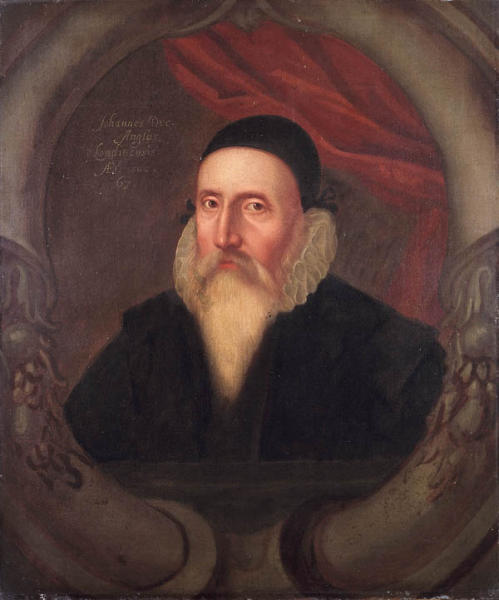
John Dee Portrait- Ashmolean Museum

John Dee Portrait- Ashmolean Museum

February, 1582

Mortlake

Light flooded through the west window illuminating the simple study. The doors were closed against the noise of his toddler children. Within was sanctuary. Some especially interesting manuscripts had been hidden in a traveling bag secreted inside the chimney. The comings and goings at Mortlake had drawn many rumors which John Dee had carefully tried to sidestep. Owning one of the best libraries in Europe drew many scholarly types. Dee’s interests included math, astronomy, astrology, navigation, and the occult. He had access to the powerful ministers of Queen Elizabeth I’s court as well as to the Queen herself. Dee’s interests were not unique because many at court dabbled, but Dee hated the caricatured image created by the term “arch conjuror” he had been given in some circles.

Dee called his work optical science and for him crystal gazing was just another way of discovering how the universe worked much like using a telescope to understand the motion of the stars. But Dee had a problem. Not having the power to scry himself, he had to rely on others to do the gazing for him. Previously he had worked with Barnabas Saul but Saul had disappeared a few days earlier. Now a man named Talbot (later known as Edward Kelley) had appeared on his doorstep claiming to be able to do what Saul had done.

Dee’s expectations were modest but using a crystal ball, Talbot soon had a vision of the archangel Uriel. Unable to resist access to such a highly placed spirit, Dee asked about a coded manuscript he possessed. Uriel told him that The Book of Soyga (a copy resides in the British Library) was revealed to Adam in paradise and could only be understood with the help of Archangel Michael. In a later session, Uriel told Dee to construct a table to facilitate future angelic communications.

The table was to be set into four divine wax seals and each seal had to contain an image revealed by the angel. On the top of the table, resting on the Seal of God, a crystal ball or shew stone would be placed.

Objects belonging to Dee at the British Museum (photo: British Museum)

Objects belonging to Dee at the British Museum (photo: British Museum)


Later in the week, Talbot had a vision of the Archangel Michael anointing Dee. There was no doubt in Dee’s mind that some very special work lay ahead of the two men. Over the next decade Dee and Kelley would receive and communicate in Enochian, a fully developed angelic language. People still puzzle over those messages and their importance.

For more investigation:

John Dee’s Conversations with Angels– Deborah E. Harkness

The Queen’s Conjuror– Benjamin Woolley

John Dee’s Five Books of Mystery– Original Sourcebook of Enochian

Magic- Joseph H. Peterson

The Complete Enochian Dictionary– Donald C. Laylock

Enochian Alphabet- Vincent Bridges (YouTube- video, the importance of Dee’s

communication )

31 Comments

Filed under alchemy, Books, Spiritual/Mysticism

WALKING THE LABYRINTH

Cretan Labyrinth

Cretan Labyrinth

A book I read recently featured a labyrinth and I got to wondering about them. Here’s what I’ve learned. Although maze and labyrinth are often used interchangeably, there are distinctions for the purest. A labyrinth features a single, non-branching path leading to a center. Unlike a maze, the path of the labyrinth is not intended to be difficult or confusing. So no corn labyrinths for Halloween, please! Labyrinths have appeared in most cultures at some point or another across the globe. The designs have occurred on baskets, pottery, body art, caves, and churches. Their meaning is not fully understood, which made me think about crop circles. From Roman to Renaissance times, most labyrinths have traditionally been unicursal.

Labyrinths reached their most grand expression in the gothic cathedrals of northern France (Chartres, Reims, Amiens). These were magnificent pavement labyrinths set in the floor. Some believe pilgrims walked these paths in prayer or meditation although it was never an early Christian practice. Some guide books of the 18th Century refer to the practice of walking the labyrinth instead of making a costly journey to the Holy Land. No one really knows though if pilgrims did this. The grand medieval labyrinths probably did inspire the later turf mazes found in the UK.

Chartres Cathedral, France

Chartres Cathedral, France

Walking a labyrinth can be seen as a pilgrimage moving toward salvation or enlightenment. Lately there has been a resurgence of interest in the use of labyrinths as a spiritual tool. More and more are being built. If you go to the Labyrinth Society’s website (below), you can search for one near you. I was surprised to see how many are in and around Denver. Many of these are connected to churches or are in private hands, but there is certainly a chance for me to walk the labyrinth.

Edinburgh Labyrinth- photo by Di Williams

Edinburgh Labyrinth- photo by Di Williams

Locate a labyrinth near you: http://www.labyrinthlocator.com

Make your own finger labyrinth:
http://http://www.pattonhq.com/links/uccministry/labyrinth.html


109 Comments

Filed under Spiritual/Mysticism