IMAGINE COMPASSION NOW

photo: Kopp, 2006

photo: Kopp, 2006

Back in 2008, Karen Armstrong, a religion scholar gave a TED talk. In it, she proposed a movement by multi-faith, multi-national groups which would promote compassion worldwide by activating the Golden Rule. Her idea led to the development of the Charter for Compassion. The Council of Conscience, consisting of representatives of many faiths and many national groups, together with input from thousands who responded online resulted in the current Charter for Compassion. The goal of the Charter is to highlight common ground amongst all major religions and all religious traditions. Specifically, they all share compassion and the Golden Rule.

Since that time, tens of thousands have signed the Charter online. Public events, discussions, and readings of the Charter have taken place bringing compassion more and more into public awareness. Now it’s our turn. This is a call to action to connect to the heart and manifest a bigger Truth than any one of us. How Karen’s idea takes form (or fails to take form) depends on our actions. I don’t really know what my part in this will be and I don’t know what your role is either. I’ve read and signed the Charter and brought it into my consciousness. Now it’s your turn. Here’s the Charter.

THE CHARTER FOR COMPASSION

The principle of compassion lies at the heart of all religious, ethical and spiritual traditions, calling us always to treat all others as we wish to be treated ourselves. Compassion impels us to work tirelessly to alleviate the suffering of our fellow creatures, to dethrone ourselves from the centre of our world and put another there, and to honour the inviolable sanctity of every single human being, treating everybody, without exception, with absolute justice, equity and respect.

It is also necessary in both public and private life to refrain consistently and empathically from inflicting pain. To act or speak violently out of spite, chauvinism, or self-interest, to impoverish, exploit or deny basic rights to anybody, and to incite hatred by denigrating others—even our enemies—is a denial of our common humanity. We acknowledge that we have failed to live compassionately and that some have even increased the sum of human misery in the name of religion.

We therefore call upon all men and women ~ to restore compassion to the centre of morality and religion ~ to return to the ancient principle that any interpretation of scripture that breeds violence, hatred or disdain is illegitimate ~ to ensure that youth are given accurate and respectful information about other traditions, religions and cultures ~ to encourage a positive appreciation of cultural and religious diversity ~ to cultivate an informed empathy with the suffering of all human beings—even those regarded as enemies.

We urgently need to make compassion a clear, luminous and dynamic force in our polarized world. Rooted in a principled determination to transcend selfishness, compassion can break down political, dogmatic, ideological and religious boundaries. Born of our deep interdependence, compassion is essential to human relationships and to a fulfilled humanity. It is the path to enlightenment, and indispensable to the creation of a just economy and a peaceful global community.

To sign the Charter for Compassion: www.charterforcompassion.org/the-charter
If you do sign it, let me know in the comments below. Please feel free to reblog, FB, or tweet this.

60 Comments

Filed under Political, Spiritual/Mysticism

Which Element Are You?

five elements

Charles Moss, MD explores the wisdom of ancient Taoist medicine and its application in the Power of the Five Elements. Dr. Moss has been involved with integrative medicine combining the best of western and eastern medicine since 1978. He opened one of the first integrative clinics and has been on the forefront of bringing acupuncture and the Five Element system to the US.

By completing a survey in his book you can identify which element (wood, earth, fire, water, metal) in the system best explains your reaction to stress. Once you’ve identified your element, the good doctor explores how to make the most of your natural strengths while combating your weaknesses. You may be able to skim through one of the early chapters to identify your primary element but even with careful reading, I thought I was metal only to find through the questionnaire that I was primarily wood followed by metal. Interestingly, my husband turned out to be metal and then wood. In this system, every one of us is a unique combination of all the elements. There is no good or bad element.

Each of us experiences stress in our lives and the five elements reveal our typical response to those. Here are the stress responses for each of the elements. You may resonate with one or two of them.

WOOD– anger, frustration

EARTH- search for sympathy, attention, understanding

FIRE– loss of joy, emotionally flat

WATER– paralyzing fear, fatigue, immobility

METAL– depression, isolation, rigid morality

Acupuncture Points- by Permacharts Inc.

Acupuncture Points- by Permacharts Inc.


The Taoist system in place in China in 200 BCE, emphasized physical health and spiritual well-being. The Nei Jing, the textbook of the first holistic health care system, described a method on adapting to stressors through knowing how. The greatest insight into a long and healthy life came from self-knowledge, a positive attitude, and spiritual practice. These are the same realizations western medicine is beginning to embrace. This book provides the necessary insights to learning the knowing how of good health through the Five Element system. Some of what is suggested will already be familiar if you have some experience in mind- body science. I am most excited to learn and incorporate the acupuncture points that Dr. Moss suggests for regaining adaptation for each of the elements. Having some experience with EFT (tapping acupuncture points) I know first-hand the power and therapeutic value of acupuncture and I’m eager to incorporate these. I hope you will explore the Five Element system to learn more about yourself and how to take care of the precious vessel that is your body.

33 Comments

Filed under Energy medicine, Spiritual/Mysticism

WHEN DEE MET KELLEY

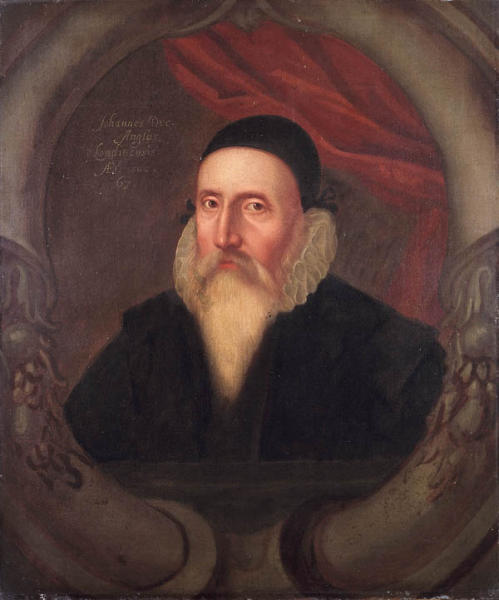
John Dee Portrait- Ashmolean Museum

John Dee Portrait- Ashmolean Museum

February, 1582

Mortlake

Light flooded through the west window illuminating the simple study. The doors were closed against the noise of his toddler children. Within was sanctuary. Some especially interesting manuscripts had been hidden in a traveling bag secreted inside the chimney. The comings and goings at Mortlake had drawn many rumors which John Dee had carefully tried to sidestep. Owning one of the best libraries in Europe drew many scholarly types. Dee’s interests included math, astronomy, astrology, navigation, and the occult. He had access to the powerful ministers of Queen Elizabeth I’s court as well as to the Queen herself. Dee’s interests were not unique because many at court dabbled, but Dee hated the caricatured image created by the term “arch conjuror” he had been given in some circles.

Dee called his work optical science and for him crystal gazing was just another way of discovering how the universe worked much like using a telescope to understand the motion of the stars. But Dee had a problem. Not having the power to scry himself, he had to rely on others to do the gazing for him. Previously he had worked with Barnabas Saul but Saul had disappeared a few days earlier. Now a man named Talbot (later known as Edward Kelley) had appeared on his doorstep claiming to be able to do what Saul had done.

Dee’s expectations were modest but using a crystal ball, Talbot soon had a vision of the archangel Uriel. Unable to resist access to such a highly placed spirit, Dee asked about a coded manuscript he possessed. Uriel told him that The Book of Soyga (a copy resides in the British Library) was revealed to Adam in paradise and could only be understood with the help of Archangel Michael. In a later session, Uriel told Dee to construct a table to facilitate future angelic communications.

The table was to be set into four divine wax seals and each seal had to contain an image revealed by the angel. On the top of the table, resting on the Seal of God, a crystal ball or shew stone would be placed.

Objects belonging to Dee at the British Museum (photo: British Museum)

Objects belonging to Dee at the British Museum (photo: British Museum)


Later in the week, Talbot had a vision of the Archangel Michael anointing Dee. There was no doubt in Dee’s mind that some very special work lay ahead of the two men. Over the next decade Dee and Kelley would receive and communicate in Enochian, a fully developed angelic language. People still puzzle over those messages and their importance.

For more investigation:

John Dee’s Conversations with Angels– Deborah E. Harkness

The Queen’s Conjuror– Benjamin Woolley

John Dee’s Five Books of Mystery– Original Sourcebook of Enochian

Magic- Joseph H. Peterson

The Complete Enochian Dictionary– Donald C. Laylock

Enochian Alphabet- Vincent Bridges (YouTube- video, the importance of Dee’s

communication )

31 Comments

Filed under alchemy, Books, Spiritual/Mysticism

WALKING THE LABYRINTH

Cretan Labyrinth

Cretan Labyrinth

A book I read recently featured a labyrinth and I got to wondering about them. Here’s what I’ve learned. Although maze and labyrinth are often used interchangeably, there are distinctions for the purest. A labyrinth features a single, non-branching path leading to a center. Unlike a maze, the path of the labyrinth is not intended to be difficult or confusing. So no corn labyrinths for Halloween, please! Labyrinths have appeared in most cultures at some point or another across the globe. The designs have occurred on baskets, pottery, body art, caves, and churches. Their meaning is not fully understood, which made me think about crop circles. From Roman to Renaissance times, most labyrinths have traditionally been unicursal.

Labyrinths reached their most grand expression in the gothic cathedrals of northern France (Chartres, Reims, Amiens). These were magnificent pavement labyrinths set in the floor. Some believe pilgrims walked these paths in prayer or meditation although it was never an early Christian practice. Some guide books of the 18th Century refer to the practice of walking the labyrinth instead of making a costly journey to the Holy Land. No one really knows though if pilgrims did this. The grand medieval labyrinths probably did inspire the later turf mazes found in the UK.

Chartres Cathedral, France

Chartres Cathedral, France

Walking a labyrinth can be seen as a pilgrimage moving toward salvation or enlightenment. Lately there has been a resurgence of interest in the use of labyrinths as a spiritual tool. More and more are being built. If you go to the Labyrinth Society’s website (below), you can search for one near you. I was surprised to see how many are in and around Denver. Many of these are connected to churches or are in private hands, but there is certainly a chance for me to walk the labyrinth.

Edinburgh Labyrinth- photo by Di Williams

Edinburgh Labyrinth- photo by Di Williams

Locate a labyrinth near you: http://www.labyrinthlocator.com

Make your own finger labyrinth:
http://http://www.pattonhq.com/links/uccministry/labyrinth.html


109 Comments

Filed under Spiritual/Mysticism

THE MYSTERY OF THE THIRD STEP

Mt. Everest, 1924

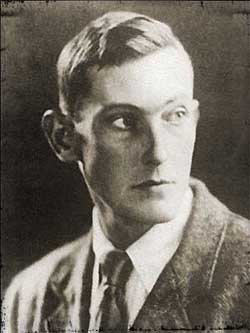
George Mallory

George Mallory

At age 37, George Mallory believed his third attempt to climb Everest would be his last. He joined the British 1924 Everest Expedition led by General Charles Bruce to finally accomplish his dream. Moving up the mountain in pairs, the team took on the quest without the aid of modern climbing gear or equipment. If you look at photos from the time period, it’s laughable to see how they are dressed. They look like English gentlemen out for a stroll on the moor. Maybe that’s one of the reasons so many modern climbers hold Mallory in such high esteem. They had so little, tried so hard, and just may have succeeded in realizing their dream. With high altitude climbing in its infancy, Mallory chose the 22 year old, Andrew Irvine to make the push for the summit owing to Irvine’s ability to keep the temperamental oxygen machines working.

Andrew Irvine

Andrew Irvine

From Advanced Base Camp (21,330 ft.), Mallory and Irvine set off on June 4, 1924. They made good time pushing up the mountain in good weather. On June 8th, they were spotted by Noel Odell at a location many believe to be the third step. A cloud moved in blocking any further view, and from that point on, Mallory and Irvine disappeared into history. They did not return to camp and were presumed dead after a time. Since then, there has been much speculation as to whether or not Mallory and Irvine summited Everest and beat out Sir Edmund Hillary and Tenzin Norgay by several decades.

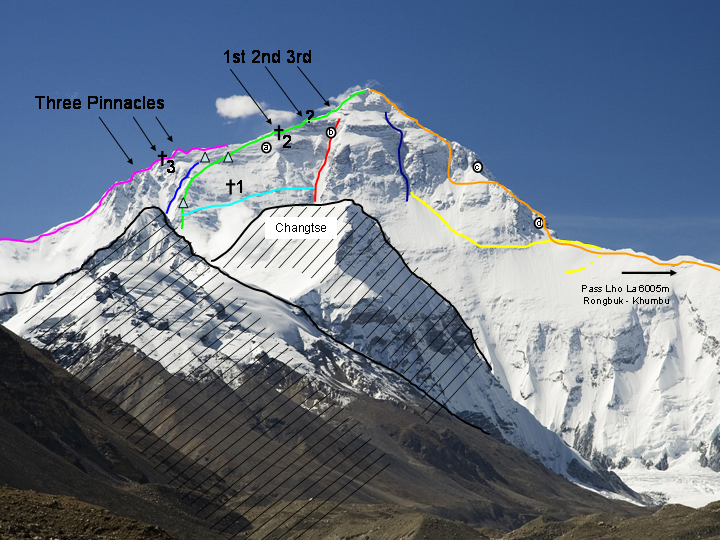
Mount Everest, north side Photo & graphics by Luca Galuzzi

Mount Everest, north side
Photo & graphics by Luca Galuzzi

Green line: Mallory’s 1924 route
3rd- is Third Step
t1- location of Mallory’s body, discovered 1999.

And they very well may have. Mallory’s body was discovered in 1999 by a team looking to solve this mystery. The location of the body, far below the steps, indicates to some that Mallory had to be descending after summiting when he took a fatal fall. With his sun goggles tucked into a pocket, it is likely that the fall happened at night and not during the afternoon when Odell last saw them. In addition, Mallory was known to have carried a photo of his wife in his wallet with plans to leave it at the top of Everest when he summited. Although the wallet was found, the photo was not, leading many to believe he and Irvine reached the top and most likely fell on the way down. Irvine’s body has not been located but may hold some of the most fascinating of physical evidence. Andrew Irvine borrowed a camera with the intention of taking photos on the summit. Should his body rest with the camera intact, Kodak officials have said that the film is likely to be recoverable. And so mountain climbing’s most enduring mystery may someday be solved.

This mystery was so fascinating; I used it as a basis for the adventure I wrote about in INTO THE LAND OF SNOWS. What happens if the camera just surfaces one day? What would your average American teen do if he suddenly held the solution to this mystery? What would you do?


35 Comments

Filed under Books, Story behind ITLS

Free Online Conference, STARTS MONDAY, You Must Register First

QUANTUM HEALING, CONSCIOUSNESS, AND SOUL EVENT

I’ll be hanging out at this conference and so can you! I’ve heard some of these speakers before and they are worth the time investment. If you’re unavailable for the live event, they offer a replay you can watch anytime. Pick and choose what interests you most. Register today by providing an email address and get set to learn something new for 2013!

http://www.quantumhealingandsoul.com/

8 Comments

Filed under alchemy, Energy medicine, Event, Spiritual/Mysticism, Uncategorized

SCIENCE PROVES THE EXISTENCE OF ESP- Dateline 1950

All truth passes through three stages:
First it is ridiculed.
Second, it is violently opposed.
Third, it is accepted as self-evident.
                                                                                            Arthur Schopenhauer

I’m excited to be able to write about an intriguing book suggested by a blog reader a while ago. The quote above is the starting point for Science and Psychic Phenomena- Fall of the House of Skeptics by Chris Carter. Carter is a Canadian, schooled at Oxford, who exhibits much courage in taking up a thorough review of parapsychology, its scandals, intriguing characters, research, and advances an idea about why parapsychology remains controversial.

Science and Psychic

Honestly, the existence of psi (including telepathy, clairvoyance, precognition, and psychokinesis) has already been proven to me by personal experience and I’m not alone. One study indicated that about 67% of Americans have had an ESP * experience. Polls taken over decades have shown that a majority of Americans already believe these things happen so what I’m going to get into here is a bit academic. Why is it that the discussion of these topics is still so taboo in some parts of the scientific community and in some parts of society? And what is the truth regarding scientific research into them?

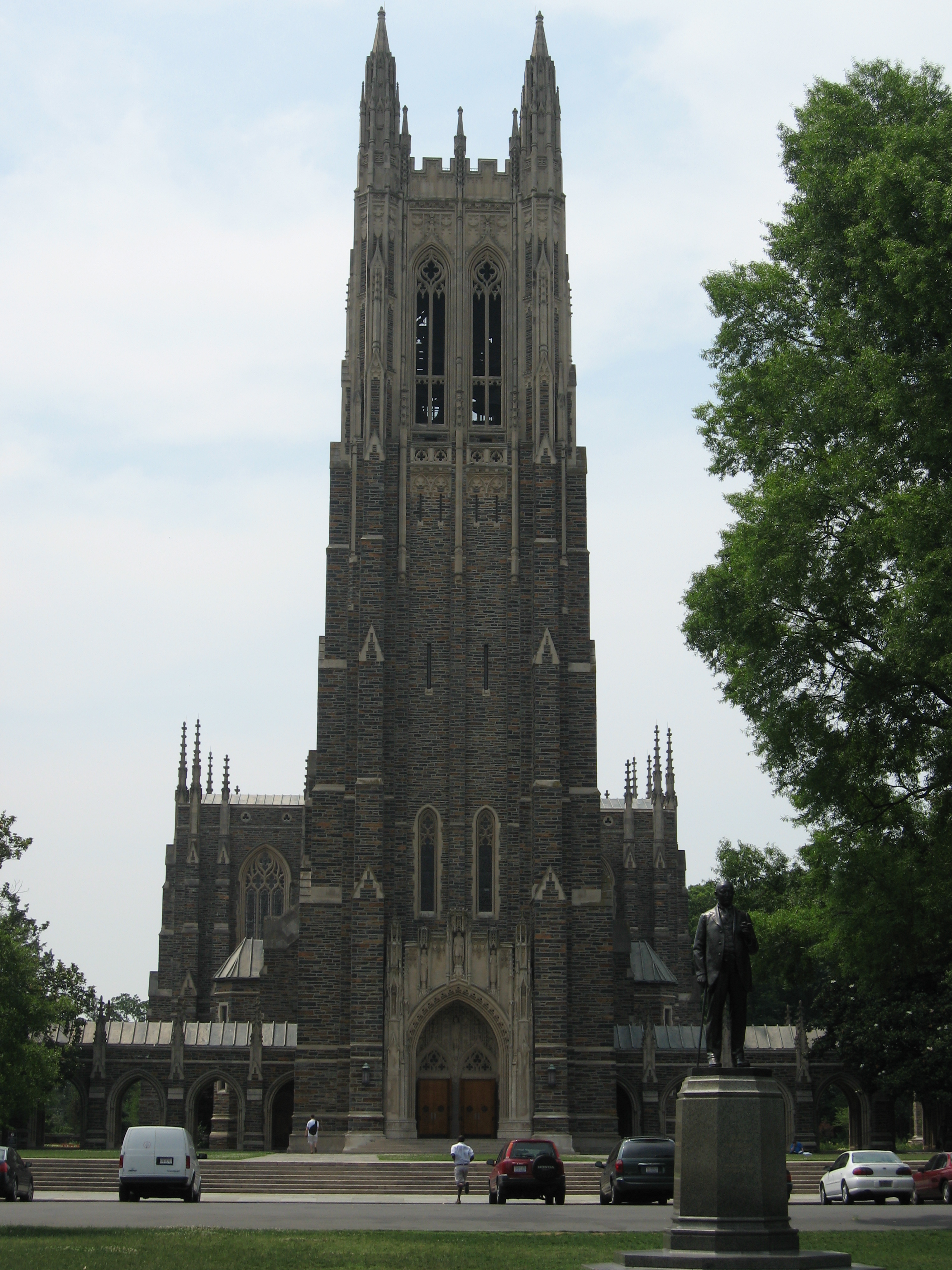
Duke University

Duke University

Let’s look at the research first. It was J.B. Rhine at Duke University who first brought ESP testing into the laboratory. In the early 30s, Rhine and Karl Zenner conducted trials of card guessing that laid the foundation for telepathy research. By 1940, nearly one million trials had been performed which eliminated critics early objections that sensory leakage might be causing the results. Experiments performed at other labs also confirmed Rhine’s results. There was something there. In the 1980s, Charles Honorton continued work in telepathy by conducting computer automated experiments. With an expected hit rate of 25%, Honorton’s studies overall hit rate was 34% with the results occurring by chance alone estimated to be 45,000 to 1. Replication studies were conducted into the 1990s with similar results.

There are five chapters in the book that outline the ins, outs, and fights that resulted when the studies were released. The conclusion really is that if this research had been produced in any other field, it would have been easily accepted as early as 1950!

People have reported experiencing PSI for thousands of years and there is solid scientific evidence to support those claims. Why does it remain so controversial? Author Chris Carter believes that PSI acceptance threatens certain people’s worldview. This worldview is called materialism and is a byproduct of an outdated 17th Century model of science. Many skeptics believe that the existence of PSI is impossible because it violates “known” science. This is simply not true. Science has evolved beyond the old science of Newtonian physics. In fact, the latest science of quantum physics doesn’t deny the existence of PSI, but rather points directly to it. So how to resolve the conundrum? Science has spoken, but the skeptics remain unconvinced. I’ll let noted Nobel Prize winning physicist Max Planck close for me.
“a new scientific truth does not triumph by convincing its opponents and making them see the light, but rather because its opponents eventually die, and a new generation grows up that is familiar with it.”

Max Planck

Max Planck

* Note: ESP includes telepathy, clairvoyance, and precognition.

Psi phenomena includes ESP and psychokinesis

ALSO SEE: video SOMETHING UNKNOWN IS DOING WE DON’T KNOW WHAT- Telekan 2009-the science behind psychic phenomena, with interviews by leading parapsychology researchers including Harold Puthoff, Charles Tart, Dean Radin, Rupert Sheldrake, Edgar Mitchell.  www.somethingunknown.com 


39 Comments

Filed under Book Review, Books, PSI, YA

ARE YOU A POST MATERIALIST?

My son’s home from university and one of our conversations turned to the economy and how hard it is to find even part-time, entry level work. He’s sent out something like 80 applications, done some interviews, and over the course of months, has just recently landed something part-time. The talk eventually wound around to the idea that my husband and I are post materialists. Now that’s not a term I know and my son delights in sharing what he has learned. As a parent, I love these times when the kids get to educate me. “So what are your girlfriend’s parents then?” I ask him. “Materialists”, he answers as if I should already know that. I actually did know that.

Anyway, further investigation on my part revealed that Ronald Inglehart developed the idea of post materialism in the 1970s as a sociological theory to explain an ongoing transformation of individual values within a society. He argued that as western nations achieved a level of economic prosperity and physical security, its members transformed their values seeking more autonomy and self-expression. Ah, this sounds a lot like Maslow’s hierarchy of needs. As people meet their basic survival requirements, we move up the pyramid until we are striving for self-actualization. Maslow confined his theory to how individuals are transformed and Inglehart wanted to see how societies as a whole might be transformed.

Maslow's Hierarchy of Needs, created by J. Finkelstein, 2006

Maslow’s Hierarchy of Needs, created by J. Finkelstein, 2006


So to be a post materialist, you must first meet your basic survival needs (food, shelter, security). OK, done. Once that is accomplished you move up Maslow’s hierarchy and as you do, you start to realize you’re no happier than when you were struggling. This brings to mind Daniel Gilbert’s book, Stumbling on Happiness. I believe it was in that book that I first learned American happiness peaked in the 1950s. BEFORE I WAS BORN! Sixty plus years later, we have higher incomes, higher levels of education, better health care, bigger houses, more cars but we are less happy overall. Remember when we were told (and believed) that he (or she) who has the most toys wins? We played the game, we toed the line, we consumed and bought all the right stuff, we competed with the Joneses, and we became… less happy. Maybe we were even miserable because the promise of happiness slipped away as we had to go looking for a storage shed to rent for all the loot that was supposed to make us positively giddy.

Stumbling on Happiness


We looked around and saw it wasn’t working. We stopped playing the game. We got rid of the excess stuff and looked inside to see what would fill the void. We began to talk about “downsizing”. The value shift from possessing things to experiencing and self- expression took hold.

Inglehart recognized that younger people (raised in economic security) were more likely to identify with the values of post materialism. But older people who were raised with the struggle of material existence may or may not shift out of that paradigm. Actually, Inglehart’s ideas remain controversial. Surprisingly, we don’t have good statistical information to measure value changes in the US. The World Value Survey of 2000 (Wikipedia) did give some indication of post materialism worldwide. The highest percentage of post materialists were found to be in Australia with 35%. Canada has 29% while the US has 25 % of the population being post materialist.

So being a minority in the US, I will be moving this year and continuing my efforts to downsize. I will continue to reject the notion that he who has the most toys wins. I will refuse to believe that my worth as an individual comes solely from consuming. I will pursue balance and harmony. And I will remember happiness is a choice for the post materialist and materialist alike. Happy 2013!


https://amzn.to/30oq1NL

137 Comments

Filed under Books, Political, Spiritual/Mysticism

THE LINE BETWEEN FACT & FICTION

tantra

Since the release of INTO THE LAND OF SNOWS, there have been some questions concerning what’s real and not real in the book. From the perspective of this being a book whose main theme concerns defining that very line, it’s a somewhat amusing question. I concern myself with it because I’ve heard some people dismiss the book as fantasy. But that’s not the whole story.

The book is set in the magical Himalayas surrounded by a rich cultural tradition. In such a place, my job as author was relatively easy. I chose concepts and ideas already present there to create a story around an American teenager. I made up very little.

Now as to the facts.

1. Locations- The map at the beginning of the book accurately depicts the placement of real locations Blake would visit along his route, had Blake actually gone there. But the careful reader will notice that about half way through the book, Blake continues his journey, but the map stops. This is because Blake has left the material reality of our world. An alternate reality opens up for him to fully experience the magic and potential for enlightenment.

2. Mallory& Irvine- The story of these climbers disappearing into legend while on the Third Step is true. The camera Mallory carried that day is still missing. We don’t know (for sure) who summited Everest first, although Hillary is officially credited with it.

3. Yetis- These animals/beings remain a mystery. Sherpa culture recognizes different kinds of yetis. I took great liberty with the Tantric yidam concept.

4. Baian-Kara-Ula Mountains- There are legends of star people and an origination story. As late as the 1950s, stories of the Chinese gathering evidence in the region exist.

5. Chakra points- There are many different systems. Tibetans usually depict 5 while Indian schools generally have 7. Research by Dr. Hiroshi Motoyama revealed the heart chakra produced measurable physical light.

6. Singing Bowls- Are used for healing.

7. Lung-gom-pa/Tumo/Yidam- Are Tantric practices.

8. Birds- The sneaky placement of rare birds in the region was my invention and homage to HH. The 16th Karmapa, who loved birds.

25 Comments

Filed under Books, Spiritual/Mysticism, Story behind ITLS

A BEATRIX POTTER CHRISTMAS

IM000004.JPG

The Christmas tree is up and as I peruse ornaments collected over decades, I’m struck by how many of them are animals. There are cats and dogs, rabbits and squirrels, hedgehogs and birds (a humming bird, blue jay, goose, partridge), and cows and horses. At the back door, I struggle with getting sunflower seeds and nuts out for my squirrels. Three inches of snow have to be cleared before I can lay down six piles of seed to accommodate the squirrels. After our dog died, we started feeding birds off our deck but soon found the squirrels to be more entertaining. The birds still come to the feeder and the overflow trickles down to feed a family of field mice who will come onto the deck once the squirrels have had their fill. I won’t see the bunny today because the storm is intensifying but I take comfort that I’ll see him tomorrow once the snow melts off. He was here earlier though; because I see his tracks crisscross the yard. The ornaments on the Christmas tree and the activity in the backyard scream BEATRIX POTTER. I live in a world she knew.

Beatrix Potter

Helen Beatrix Potter was born in 1866 in London. She is best remembered for her children’s stories featuring animals. As children, she and her brother spent many happy family vacations in Scotland and the English Lake District. Undoubtedly, the freedom to explore and interact with nature as a child grounded Beatrix in the natural world and fostered her connection to the land and its creatures. She and her brother made pets of wildlife including rabbits, a hedgehog, mice, and bats. Beatrix’s talents in drawing and painting emerged in childhood and were encouraged by her parents. In her teens, she wandered the Lake District sketching and immersing herself in nature. She took a keen interest in archeology, geology, entomology, and mycology. By the late 1890s, she had become adept at scientific illustration concentrating on watercolors of local fungi. She even had a paper on fungi reproduction presented at the Royal Botanic Gardens (women were not allowed to attend).

Peter

It wasn’t until her mid- 30s that Beatrix took a set of picture letters she had written to children and turned them into her first book. She had The Tale of Peter Rabbit printed in 1901. Publishers turned down the opportunity to publish the book failing to see its merit (think Harry Potter in the Edwardian Age,  JK Rowling was also turned down by multiple publishers). Along came Frederick Warner who published The Tale of Peter Rabbit with color illustrations the following year. Beatrix’s book was highly successful and so were the two (The Tale of Squirrel Nutkin and The Tailor of Gloucester) that came soon after. From then on, Beatrix published two or three books a year. Later her interests in farming and preserving the Lake District became foremost in her life, but she is still remembered fondly for the animal characters and stories she created.

www.beatrixpottersociety.org.uk

http://www.peterrabbit.com

Miss Potter (2006), the movie with Renee Zellweger & Ewan McGregor


52 Comments

Filed under animals, Book Review, Books