Tag Archives: mysticism

WELCOME BACK FRANCIS


St. Francis, 13th Century

St. Francis, 13th Century

A couple of years ago I listened to one of those Great Courses lectures on St. Francis of Assisi. I patiently waited through all the talk about his early beginnings, his military experience, his illness, his rejection of society, and his eventual creation of a new order. Most of it was dry and rather matter-of-fact. Where was the meat? Where was the mystical Francis I’d heard about? Where were the stories, the hagiography, that made Francis one of the most loved and recognized saints of all time? I walked away from the lectures shaking my head in disappointment. It wasn’t until later that my reading caught up with the reality. I had been very naïve believing a history and art professor would ever broach the subject of mystical experience. It wasn’t done; even an academic degreed in comparative religion would shy away from this discussion. How sad because isn’t that what many of us hunger for?

Francis has whispered from time to time to me. A statue in someone’s garden, the visit of the Pope this fall to Assisi, a well-known spiritual teacher planning a workshop there, St. Francis hospital visible from my new house. Then recently, Pope Francis was proclaimed Time’s Man of the Year. Francis is present in ways he hasn’t been in a long time. What can a twelfth century saint have to say to the modern world? Maybe a lot.

St. Francis in Ecstasy Caravaggio, 1594

St. Francis in Ecstasy
Caravaggio, 1594

Let’s dispense with the relevant historical details (and don’t worry it won’t take twelve lectures) to seek out a deeper meaning for Francis in our time. Francis was born Giovanni di Pietro di Bernadone around 1181. Born into a wealthy merchant family, he enjoyed all the advantages of his station and even went off to war fighting for Assisi. Some kind of vision compelled him to return home where he subsequently lost his zeal for the kind of life he’d been previously living and he began to reject it. He left his father’s silk business, took to serving the poor and lepers, and gained a following. Francis eventually went on to found the Order of the Friars Minor, the Order of St. Clare, and the Third Order of St. Francis.

It was in San Damiano that Francis had a powerful mystical experience which was to frame his life’s work. While praying before an icon, he had a vision of Jesus who spoke to him and said, “…go and repair My house which, as you can see is falling into ruins.”  Francis’ interpretation resulted in him raising money to repair the physical church he was in. Of course, Francis’ mission was not a literal one and called him instead, to restore the institution of the Church.
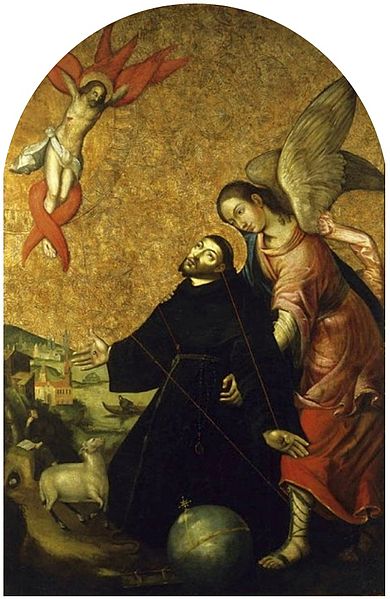
Stigmatization of St. Francis Matthias Kargen, 1664

Stigmatization of St. Francis
Matthias Kargen, 1664

Although never ordained, Francis’ calling was manifested in a simple life of poverty emulating the life of Christ. His followers were “To follow the teaching of our Lord Jesus Christ and walk in his footsteps.” He was devoted to his spiritual practice and at times would withdraw from life to develop it. He had guiding visions throughout his life, was seen levitating, and was the first recorded person to receive the wounds of Christ (stigmata). Francis was a mystic, but he was also a mystic who brought back what he learned and shared it.
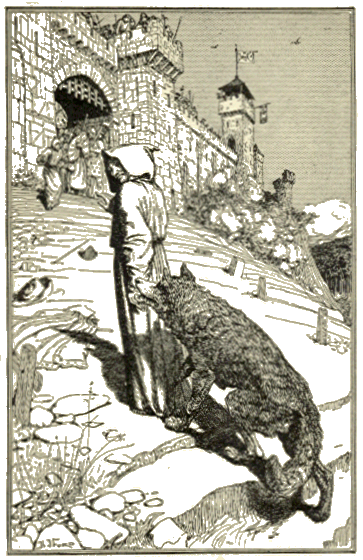
St. Francis leads the wolf of Gubbio. HJ Ford, 1912

St. Francis leads the wolf of Gubbio.
HJ Ford, 1912

Two of the most widely known miracles told about Francis involve his ability to work with animals. In the town of Gubbio, a wolf threatened the townsfolk. Francis intervened and made a pact with the wolf. Thereafter, the wolf remained peacefully near the village and the people fed it. The other story concerns an incident where Francis was trying to preach over the noisy chatter of swallows. He asked the birds to be silent and to the amazement of the crowd, they did. That famous story is the reason why Francis statues and art depictions often have a bird. Francis is the patron saint of animals and the environment.

As we draw near to Christmas and many churches display a nativity scene (Francis is credited with creating the first nativity scene), I hope you will remember a simple saint who lived an exemplary life devoted to poverty and service. His mystical connection to the Universe (God, if you prefer) was the powerhouse of his practice.

For More:

Canticle of the Sun: http://en.wikipedia.org/wiki/Canticle_of_the_Sun

St. Francis Peace Prayer: http://en.wikipedia.org/wiki/Prayer_of_Saint_Francis

Book: The Life and Prayers of St. Francis

44 Comments

Filed under animals, Book Review, Books, Spiritual/Mysticism

WHO WANTS TO BE NORMAL ANYWAY?

“The trembling in academic journals over how science must be falling apart because of positive evidence for psi is a desperate attempt to maintain a stable worldview where psi can’t exist.” Dean Radin, PhD

Welcome back old and new friends. It’s been a while and I wanted to share something I’m really enjoying. I’m reading Supernormal by Dean Radin. From the mystical side I’ve known that many (if not all) spiritual traditions hold that spiritual progress, especially through meditation practice, directly leads to the emergence of what we commonly call psychic ability (PSI). And these traditions also warn the seeker not to be distracted or side-lined when it happens because the spiritual path’s goal is Truth or union with the Universe (God, divine, Absolute, Reality, etc.). Leave it to scientist Dean Radin to put this to the test.

51jTUbPpTYL__BO2,204,203,200_PIsitb-sticker-arrow-click,TopRight,35,-76_AA300_SH20_OU01_

About two thousand years ago, Pantanjali (The Yoga Sutras) wrote in rather cookbook terms that if you sit down and quiet the mind and dedicate yourself to this practice, you will eventually gain supernormal powers (siddhis). Elementary siddhis as outlined by the text include telepathy, clairvoyance, precognition, and psychokinesis. And to open your mind further, Pantanjali goes on to discuss the more advanced siddhis of invisibility, levitation, invulnerability, and superstrength (homage to comic book superheroes here). Are you still with me or are you rolling your eyes and scoffing? I sense a few of you are… smiling.

If you’ve read some of my previous work, you already know that science long ago established the existence of precognition with the Rhine experiments and the meta- analysis which followed (Honorton/Ferrari). There is statistically significant evidence for precognition although its effect is small in the general population. The point is that it’s there.

In the 1990s Radin went on to look at presentiment (prefeeling instead of preknowing). Radin used a random number generator and a stock of color photos which contained calming or emotional images that were flashed on a computer screen. He collected the subject’s reaction via skin conductance levels using electrodes attached to the palm. (Radin gives an exhaustive description in the book in case anyone wants to examine all the experimental protocols.) The results indicate that people react physiologically BEFORE they see the image on the screen. The experiment is strong evidence for presentiment even though the subject does not have conscious awareness of the image.

Back to Pantanjali. In a fairly complicated experiment, Radin looked at a group of meditators and non-meditators (sixteen individuals total). Meditators with a lot of experience in non-dual techniques often can achieve a deep state of absorption (Samadhi/Samyama) where time and space evaporate. The yogic perception is that an underlying deeper reality exists beyond time and space. In this reality, past and future influence the present. We are used to thinking about the past influencing the future, but it may also be that the future is at work as well. In this way of looking at things, presentiment/precognition can be viewed as the future influencing present awareness.

In the experiment, 32 channels of EEG were measured before, during, and after exposure to unpredictable light and sound stimuli. If meditation practice developed a way to extend consciousness through time, then we would expect the meditators to exhibit prestimulus differences in EEG responses over the control group (non-meditators). The research revealed that meditators did show brain activity that anticipated an audio signal. Non-meditators did not show any significant prestimulus differences between light v. sound.* The outcome supported the idea that the meditators were accessing the future in a way consistent with Pantanjali’s description.

A reversal of the cause-effect sequence is compatible with classical and quantum physics. Physicists already accept time reversal for the quantum world, but the evidence for precognition suggests it also takes place in the macro-world.

The evidence for precognition/presentiment may excite you or it may make you very nervous but either way, it should make you pause to consider how our worldview must change. Science has to take us to new places and challenge us to think and see in new ways. Scientific laws are not carved in stone and to reject all PSI research because it doesn’t fit a materialistic worldview only slows down the inevitable. We are starting to see the ground shift. Seventy-five years of scientific evidence from all over the world indicates that humans do possess one of the siddhis Pantanjali listed. We can glimpse the future.

More Summer Reading:
Emotional Freedom (Energy Psychology)- Judith Orloff, MD
The Biology of Belief- Bruce Lipton, PhD
The Way of the Explorer- Edgar Mitchell (astronaut)
The Genie in Your Genes- Dawson Church (epigenetics)

*Reasons why the non-mediators didn’t exhibit presentiment (in this small study) may be due to the stimulus not being emotionally charged and/or the choice of measuring physiological changes might not be the best one.

67 Comments

Filed under Book Review, Books, PSI, Spiritual/Mysticism, Uncategorized

THE CHAKRAS AND SPIRITUAL GROWTH

Chakras

I recently finished reading In Search of the Miraculous- Healing Into Consciousness by Eliza Mada Dalian. It’s a book for spiritual seekers wanting a manual on the path out of fear, pain, and suffering. This is a largely down to earth book that attempts to simplify the mystical and make it accessible to the average reader. It is not St. Theresa of Avila, The Cloud of Unknowing, a Buddhist sutra, or a Sufi text. Dalian grounds her work and for that we can be thankful.

The one section I found to be particularly useful was the part concerning the development of the ego-mind in each of the chakras. Chakras can be thought of as circular energy centers, and for our purposes, we will use the traditional Indian system of seven chakras. Dalian is careful to point out that spiritual development through the chakras is not necessarily a linear one. I take that to mean that life’s trials and tribulations can have us working in any chakra at any time or in several (which seems likely given the complexity of life). Let’s take a look at the spiritual work associated with each chakra and see if you can identify where you are in the process.

Healing Into Consciousness

1st Chakra (Root): Foundations of Life: (located at the base of the spine)
Although some writings on chakras are different, Dalian identifies this chakra as the center for sexuality. The spiritual work here involves breaking through sexual fears, taboos, and conditioning.

2nd Chakra (Hara): Survival of the Physical Body: (located 2” below navel)
Here the spiritual seeker deals with fears or insecurities over your physical survival. Eventually you develop trust that the universe will take care of you.

3rd Chakra (Solar Plexus): Developing Self Power & Decision Making Ability: (located in solar plexus region)
Spiritual work here involves developing the courage to make decisions, set boundaries for protection, and accept the responsibility for one’s actions. Considerable maturing of the ego-mind happens here.

4th Chakra (Heart): Developing Unconditional Love: (located behind the sternum near the heart)
The heart chakra is the bridge between the lower instinctual chakras and the higher spiritual chakras. Dalian believes that 90 percent of humanity is stuck in the first three chakras and I’d tend to agree. The work of the spirit in the 4th chakra is to transform the body’s need for survival and the instinctual lust of self- gratification into unconditional love.

5th Chakra (Throat): Developing Individuality & Self Expression: (located at the base of the throat near the thyroid) The spiritual challenge here is to develop honesty and integrity that allows an individual to break free of old patterns, beliefs, and social conditioning to bring freedom of expression and individuality into the world. There is a turn inward for truth and compromising the soul is no longer possible. People begin to speak and live their purpose.

6th Chakra (Third Eye): Developing Wisdom & Intelligence: (located in the center of the forehead between the eyebrows)
Spiritual growth in the 6th chakra is associated with the revelation and expansion of psychic knowing. Sometimes called the opening of the third eye, the door to cosmic reality opens. An individual begins to develop extra-sensory abilities, intuition, and begins to glimpse who he/she really is in cosmic terms. Interconnectedness becomes apparent.

7th Chakra (Crown): Dissolving the Ego: (located at the top of the head, acts as the transition point between physical reality and cosmic reality)
This is what Buddhists call Enlightenment. It’s the ultimate goal, the end game. Here, spiritual work involves the death of the ego-mind and ultimate liberation. Through the 7th chakra, the life force moves from time/space reality into timeless reality of ever-evolving consciousness. It’s important to remember that enlightenment (or liberation) is available at every moment of life or at the point of physical death.

If you’d like to learn more about any of the specific challenges associated with the chakras or techniques and meditations that may be useful, grab a copy of the book. There is a whole chapter packed with resources to help. You can also visit the author’s website at www.madadalian.com.

77 Comments

Filed under Books, Spiritual/Mysticism

WHEN DEE MET KELLEY

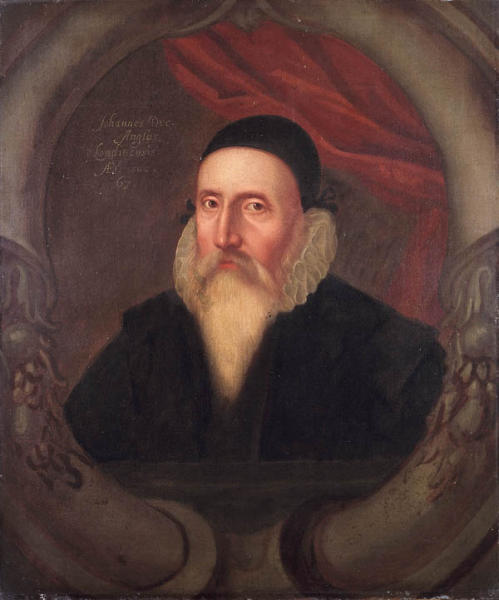
John Dee Portrait- Ashmolean Museum

John Dee Portrait- Ashmolean Museum

February, 1582

Mortlake

Light flooded through the west window illuminating the simple study. The doors were closed against the noise of his toddler children. Within was sanctuary. Some especially interesting manuscripts had been hidden in a traveling bag secreted inside the chimney. The comings and goings at Mortlake had drawn many rumors which John Dee had carefully tried to sidestep. Owning one of the best libraries in Europe drew many scholarly types. Dee’s interests included math, astronomy, astrology, navigation, and the occult. He had access to the powerful ministers of Queen Elizabeth I’s court as well as to the Queen herself. Dee’s interests were not unique because many at court dabbled, but Dee hated the caricatured image created by the term “arch conjuror” he had been given in some circles.

Dee called his work optical science and for him crystal gazing was just another way of discovering how the universe worked much like using a telescope to understand the motion of the stars. But Dee had a problem. Not having the power to scry himself, he had to rely on others to do the gazing for him. Previously he had worked with Barnabas Saul but Saul had disappeared a few days earlier. Now a man named Talbot (later known as Edward Kelley) had appeared on his doorstep claiming to be able to do what Saul had done.

Dee’s expectations were modest but using a crystal ball, Talbot soon had a vision of the archangel Uriel. Unable to resist access to such a highly placed spirit, Dee asked about a coded manuscript he possessed. Uriel told him that The Book of Soyga (a copy resides in the British Library) was revealed to Adam in paradise and could only be understood with the help of Archangel Michael. In a later session, Uriel told Dee to construct a table to facilitate future angelic communications.

The table was to be set into four divine wax seals and each seal had to contain an image revealed by the angel. On the top of the table, resting on the Seal of God, a crystal ball or shew stone would be placed.

Objects belonging to Dee at the British Museum (photo: British Museum)

Objects belonging to Dee at the British Museum (photo: British Museum)


Later in the week, Talbot had a vision of the Archangel Michael anointing Dee. There was no doubt in Dee’s mind that some very special work lay ahead of the two men. Over the next decade Dee and Kelley would receive and communicate in Enochian, a fully developed angelic language. People still puzzle over those messages and their importance.

For more investigation:

John Dee’s Conversations with Angels– Deborah E. Harkness

The Queen’s Conjuror– Benjamin Woolley

John Dee’s Five Books of Mystery– Original Sourcebook of Enochian

Magic- Joseph H. Peterson

The Complete Enochian Dictionary– Donald C. Laylock

Enochian Alphabet- Vincent Bridges (YouTube- video, the importance of Dee’s

communication )

31 Comments

Filed under alchemy, Books, Spiritual/Mysticism

WALKING THE LABYRINTH

Cretan Labyrinth

Cretan Labyrinth

A book I read recently featured a labyrinth and I got to wondering about them. Here’s what I’ve learned. Although maze and labyrinth are often used interchangeably, there are distinctions for the purest. A labyrinth features a single, non-branching path leading to a center. Unlike a maze, the path of the labyrinth is not intended to be difficult or confusing. So no corn labyrinths for Halloween, please! Labyrinths have appeared in most cultures at some point or another across the globe. The designs have occurred on baskets, pottery, body art, caves, and churches. Their meaning is not fully understood, which made me think about crop circles. From Roman to Renaissance times, most labyrinths have traditionally been unicursal.

Labyrinths reached their most grand expression in the gothic cathedrals of northern France (Chartres, Reims, Amiens). These were magnificent pavement labyrinths set in the floor. Some believe pilgrims walked these paths in prayer or meditation although it was never an early Christian practice. Some guide books of the 18th Century refer to the practice of walking the labyrinth instead of making a costly journey to the Holy Land. No one really knows though if pilgrims did this. The grand medieval labyrinths probably did inspire the later turf mazes found in the UK.

Chartres Cathedral, France

Chartres Cathedral, France

Walking a labyrinth can be seen as a pilgrimage moving toward salvation or enlightenment. Lately there has been a resurgence of interest in the use of labyrinths as a spiritual tool. More and more are being built. If you go to the Labyrinth Society’s website (below), you can search for one near you. I was surprised to see how many are in and around Denver. Many of these are connected to churches or are in private hands, but there is certainly a chance for me to walk the labyrinth.

Edinburgh Labyrinth- photo by Di Williams

Edinburgh Labyrinth- photo by Di Williams

Locate a labyrinth near you: http://www.labyrinthlocator.com

Make your own finger labyrinth:
http://http://www.pattonhq.com/links/uccministry/labyrinth.html


109 Comments

Filed under Spiritual/Mysticism

THE CURIOUS CASE OF FRANCIS SCHLATTER: the Denver Messiah

Francis Schlatter

At the turn of the last century, a French cobbler took up residence in Denver. He was a quiet unassuming man who plied his trade until he had a transformative experience in which he was told by “the Father” to give up his business and devote his life to healing. He spent the next two years wandering the American West. His first efforts at healing began in California with the Indians of the San Jacinto Valley. By July 1895, he was in Albuquerque treating hundreds who gathered for his hands-on treatment.

Francis Schlatter lived simply refusing all forms of payment. He taught no new doctrine and healed by grasping the hands of the sufferer. Sometimes he was overheard to say The Lord’s Prayer, but a good portion of his healings was done in silence. He healed the blind, the deaf, the lame, and all sorts of maladies while crediting “the Father” for all of them.

In the fall of 1895, he was back in Denver staying with a friend. Outside a small house Schlatter stood near the front fence as thousands passed by for healings. So impressed was the Union Pacific Railroad executive, Superintendent K. Dickenson, after his wife’s treatment, that he allowed any of his railroad workers to leave his job and travel to Denver at the expense of the company to seek treatment. And come they did! In the short two month period in which Schlatter stood on a platform in that Denver neighborhood, it is estimated that 60,000 people received healings. Each day, the mail arrived requesting the healer bless and return hundreds of handkerchiefs. Schlatter did his best to keep up with those as well.

Newspapers picked up the story and soon other cities were clamoring for Schlatter to visit them. Men came offering Schlatter all kinds of deals in return for his presence. People who took up their places in line for the daily healing were now offered money as the wealthy and privileged sought to exploit them. Schlatter was deeply offended by the practice and some believe it was what convinced him to give up his work and flee in the night. The people of Denver were outraged when their healer disappeared. Hundreds were still arriving daily to see the healer. Search parties were sent out to find Schlatter and bring him back to Denver, against his will if necessary.

Francis Schlatter’s story is detailed in Denver’s Extraordinary Faith-Healing Messiah edited by Bill Blanning. The book contains the newspaper accounts from the time Schlatter appears in New Mexico until his disappearance. It’s interesting to read the articles written over a hundred years ago because the language is so formal and foreign to the way we write today. However, you do get a good feel for the way Schlatter was received. Hundreds of individuals who received healings are named and people genuinely felt Schlatter was doing good work. His simple way of living and goodness are portrayed. There were a few dissenters, who felt Schlatter was a fraud, but they can be counted on one hand and their motives even at the time were seen as suspect.

What is also interesting is looking back and seeing Schlatter in his own time. I was surprised to see that Spiritualism was well known and I found no derisive comments in the newspaper coverage of it. In addition, the terms animal magnetism, Christian Science, and psychic science were all used without explanation. People over a century ago were familiar with those terms. I came away feeling that mainstream people at the turn of the last century were far more open to these things than we are today.

And the end of the story. Schlatter disappeared into New Mexico for a few months where he managed to dictate his autobiography. The Life of the Harp in the Hand of the Healer by Ada Morley was released in 1897. That same year, Schlatter’s bones and possessions were discovered on a mountain in the Sierra Madre.

82 Comments

Filed under Books, Spiritual/Mysticism

DO YOU HAVE A GRATITUDE PRACTICE?

It’s Thanksgiving again and many will fleetingly acknowledge a few (or many) things they are grateful for today. Maybe you’ll go around the dinner table asking friends and family to share a few words. That reminds me of the year we did that. The kids were little and we had gathered pinecones from Plymouth and I thought it’d make a meaningful ritual to pass a pinecone and mention something we were grateful for. It was a disaster. Everyone was caught off guard and a few adults even seemed offended. How dare I require something of them when the whole idea of Thanksgiving was to stuff yourself to bursting? The pinecones sit at the bottom of a box of fall decorations never to see the light of day again. I learned.

I’ve always been a cup half-empty person. My focus was on a compulsive need to fill up the cup so I could at last be happy. When I achieve the right job, the right income, the right family, the right set of possessions, and the right body – then I will have earned the right to be happy. That’s how I was raised after all. Then I will celebrate and be grateful for having it all. For decades I existed like this (maybe you do too?).

Eventually I did come to understand how toxic this attitude is.

Nowadays, I have a gratitude practice which is simple and has turned me into more of a cup half-full person. Every night I take a few minutes to focus on the myriad of good things in my life. By choosing to see the world this way, I banish thoughts of not being good enough and not having enough. I am good enough and I certainly have enough. That’s blasphemy in our consumer driven, material world. I am a revolutionary. Are you?

98 Comments

Filed under Spiritual/Mysticism