
New Harmony, IN
(Check out my YouTube channel for more content. I post shorts and other in-depth videos there. @ellinelson6128)

I suspect most of you have heard of the Shakers. But what about the Rappites (also called Harmonists)? The Owenites?
Tucked in southern Indiana is a small town called New Harmony that came to my attention a few months prior to the recent eclipse. A weird and out of the way place where two very different groups of people attempted to create their version of a Utopian society. It sounded like a perfect place to experience the solar eclipse in Aries.
In 1803, German born, George Rapp led a group of followers who had split from their traditional Lutheran roots to establish a town where they would follow an exemplary Christian life and await Christ’s imminent return. Rapp was inspired by the philosophies of Emanuel Swedenborg, Jakob Bohme, and other forms of Esoteric Christianity. His group may also have dabbled in alchemy. In a short ten-year period, the hard-working group which functioned as a commune, built a town and successfully traded goods along the east coast and down the Mississippi. Although some historians question exactly why George Rapp chose to uproot the entire town in 1814, the book I read indicates that the Rappites became too successful and Rapp feared that idle hands, well- you know how THAT goes. Rapp sold the whole town to a successful Welsh visionary looking to start his own Utopian social experiment.


(Above: The Rappites built log cabins originally before construction began on the permanent town. Middle photo shows a natural, laurel bush labyrinth with center brick structure. Third is a communal residence building later used as a theatre by the Owenites. Last photo shows a massive communal granary built by the Rappites. The Owenites bought an entire functioning town from the Rappites and built virtually nothing.)
Robert Owen was a transformative voice for change. With his charisma, he enchanted many. Coming to the US after becoming hugely successful in the UK in the textile industry, he addressed join sessions of Congress twice. New Harmony was envisioned to be his idea of a Utopian society for the worker. Unfortunately, his experiment attracted high-minded thinker types and none of the workers necessary to run the town the Harmonists had built. Owens visionary style marked him as a man of ideas, but he lacked the ability to actually get anything up and running in the community. The New Harmony experiment lasted about two years. However, Owen’s ideas were influential and with the diligent work of his sons and the intellectuals of the town, notable lasting achievements did come. The dream of social change came through reforms in women’s (Robert Dale Owen) and worker’s rights (UK, especially), the establishment of free public libraries and museums (Smithsonian) and led to major innovations in public co-educational schools (New Harmony intellectuals).


(Above: A building believed to have been built by Owenites. Second photo shows the specimen collections gathered by the Owenite intellectuals. They were known for their interest in science (especially geology) and educational reforms. Two photos of objects from the Owenite period. Last is a painting from a collection donated in the early 20th century to the Owenite community. The Owenites were also known for their active theatre productions.)
One of the major distinctions between the Harmonists and the Owenites was the way they treated religion. In the first community, religion was at the core of the founding of the society. The later Owenites were free to choose to practice any religion, or none. Robert Owen himself professed a belief in no religion. Until—late in life, Robert Owen met a trance medium and sat for several seances. A disbeliever in everything up until that point, he went on to communicate with (allegedly) Benjamin Franklin, Thomas Jefferson, and others. In the final years of his life, he became a firm believer in Spiritualism and its promise of an afterlife. Owen’s eldest son, Robert Dale Owen also found his way into the folds of Spiritualism. Robert Dale Owen had a significant career as an Indiana legislator, US Congressman, and diplomat. He implemented many lasting social changes for women’s property rights and advocated to give women the vote, urged Lincoln to abolish slavery on moral grounds, and had a role in the construction of the Smithsonian. Robert Dale Owen went on to pen two books about the phenomenon of Spiritualism. His books, Footfalls on the Boundary of Another World (1859) and The Debatable Land Between this World and the Next (1872) are still available today.
I found New Harmony to be disappointing today. It’s a sleepy, quaint little town. Very little remains of the once thriving Harmonist community. Some of the Owenite period exists, closed and cut off behind fences. There are many pretty, well-kept Victorian homes. The local university has a few buildings it maintains and is vested in telling a certain slant of history. In the 1950s a benefactor came in to restore parts of the village and create a new artists’ colony. It was a shame she didn’t do this in the 1960s when it might have taken hold. Like so many little towns, it struggles for its place in a new world.
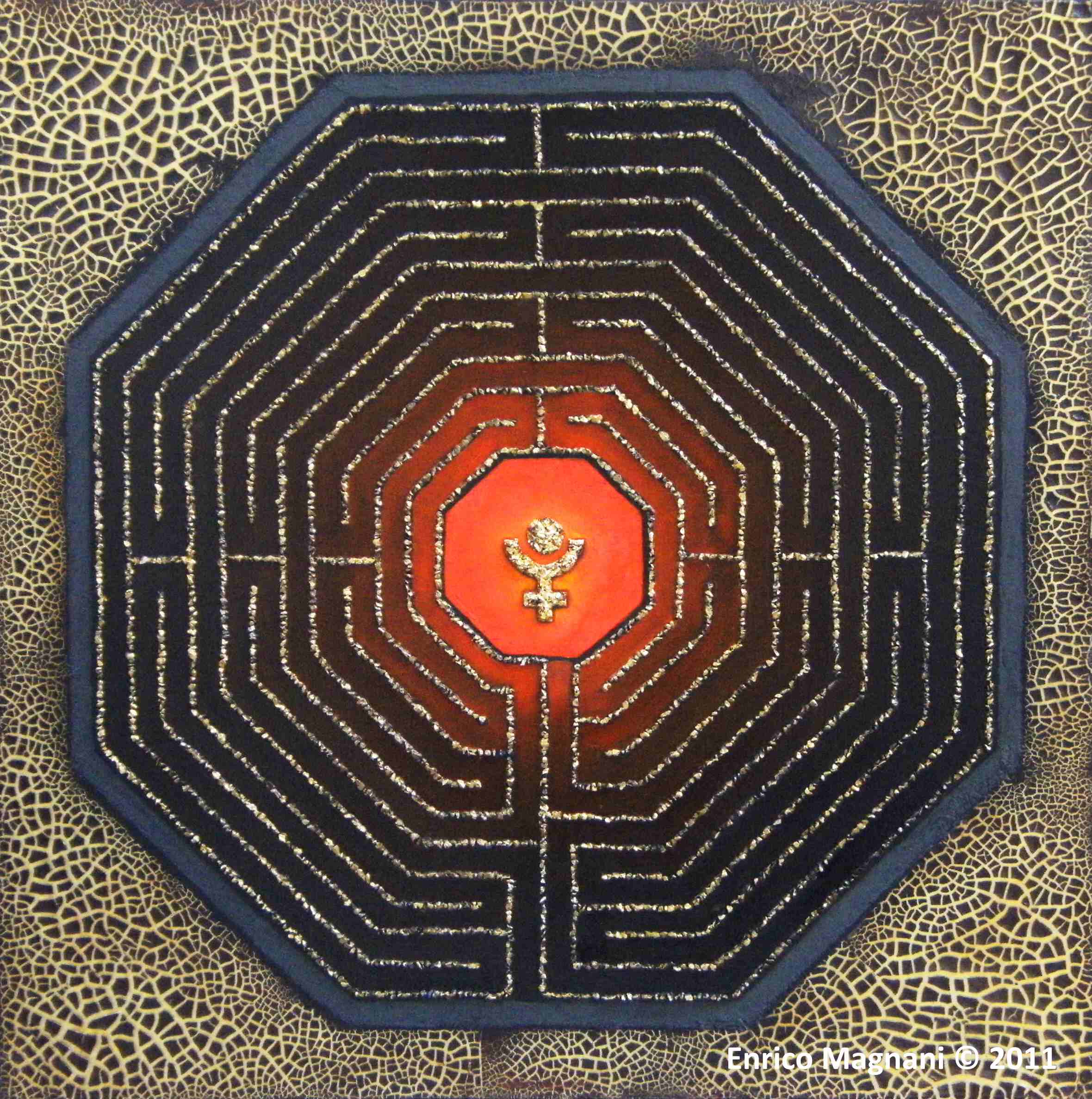
(Below are images from the modern period, post 1950. First photo is the Roofless Church, dedicated in 1960 as an interdenominational church designed by Philip Johnson. Cloisters and sculpture follow in the next two photos, also near the Roofless Church. Final photo shows the replica of the Chartres Cathedral Labyrinth built in New Harmony.)


THE FULL SOLAR ECLIPSE IN ARIES :

My Alice in Wonderland retelling is called Down the Treacle Well. The book trailer is below.
ORDER HERE: bit.ly/3roGX9f
SIGNED COPIES AVAILABLE: Contact himalayaspencerellis@yahoo.com for more info!




 ellisnelson