Tag Archives: history

WALKING THE LABYRINTH

Cretan Labyrinth

Cretan Labyrinth

A book I read recently featured a labyrinth and I got to wondering about them. Here’s what I’ve learned. Although maze and labyrinth are often used interchangeably, there are distinctions for the purest. A labyrinth features a single, non-branching path leading to a center. Unlike a maze, the path of the labyrinth is not intended to be difficult or confusing. So no corn labyrinths for Halloween, please! Labyrinths have appeared in most cultures at some point or another across the globe. The designs have occurred on baskets, pottery, body art, caves, and churches. Their meaning is not fully understood, which made me think about crop circles. From Roman to Renaissance times, most labyrinths have traditionally been unicursal.

Labyrinths reached their most grand expression in the gothic cathedrals of northern France (Chartres, Reims, Amiens). These were magnificent pavement labyrinths set in the floor. Some believe pilgrims walked these paths in prayer or meditation although it was never an early Christian practice. Some guide books of the 18th Century refer to the practice of walking the labyrinth instead of making a costly journey to the Holy Land. No one really knows though if pilgrims did this. The grand medieval labyrinths probably did inspire the later turf mazes found in the UK.

Chartres Cathedral, France

Chartres Cathedral, France

Walking a labyrinth can be seen as a pilgrimage moving toward salvation or enlightenment. Lately there has been a resurgence of interest in the use of labyrinths as a spiritual tool. More and more are being built. If you go to the Labyrinth Society’s website (below), you can search for one near you. I was surprised to see how many are in and around Denver. Many of these are connected to churches or are in private hands, but there is certainly a chance for me to walk the labyrinth.

Edinburgh Labyrinth- photo by Di Williams

Edinburgh Labyrinth- photo by Di Williams

Locate a labyrinth near you: http://www.labyrinthlocator.com

Make your own finger labyrinth:
http://http://www.pattonhq.com/links/uccministry/labyrinth.html

 

109 Comments

Filed under Spiritual/Mysticism

THE LINE BETWEEN FACT & FICTION

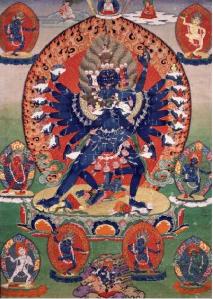
tantra

Since the release of INTO THE LAND OF SNOWS, there have been some questions concerning what’s real and not real in the book. From the perspective of this being a book whose main theme concerns defining that very line, it’s a somewhat amusing question. I concern myself with it because I’ve heard some people dismiss the book as fantasy. But that’s not the whole story.

The book is set in the magical Himalayas surrounded by a rich cultural tradition. In such a place, my job as author was relatively easy. I chose concepts and ideas already present there to create a story around an American teenager. I made up very little.

Now as to the facts.

1. Locations- The map at the beginning of the book accurately depicts the placement of real locations Blake would visit along his route, had Blake actually gone there. But the careful reader will notice that about half way through the book, Blake continues his journey, but the map stops. This is because Blake has left the material reality of our world. An alternate reality opens up for him to fully experience the magic and potential for enlightenment.

2. Mallory& Irvine- The story of these climbers disappearing into legend while on the Third Step is true. The camera Mallory carried that day is still missing. We don’t know (for sure) who summited Everest first, although Hillary is officially credited with it.

3. Yetis- These animals/beings remain a mystery. Sherpa culture recognizes different kinds of yetis. I took great liberty with the Tantric yidam concept.

4. Baian-Kara-Ula Mountains- There are legends of star people and an origination story. As late as the 1950s, stories of the Chinese gathering evidence in the region exist.

5. Chakra points- There are many different systems. Tibetans usually depict 5 while Indian schools generally have 7. Research by Dr. Hiroshi Motoyama revealed the heart chakra produced measurable physical light.

6. Singing Bowls- Are used for healing.

7. Lung-gom-pa/Tumo/Yidam- Are Tantric practices.

8. Birds- The sneaky placement of rare birds in the region was my invention and homage to HH. The 16th Karmapa, who loved birds.

25 Comments

Filed under Books, Spiritual/Mysticism, Story behind ITLS