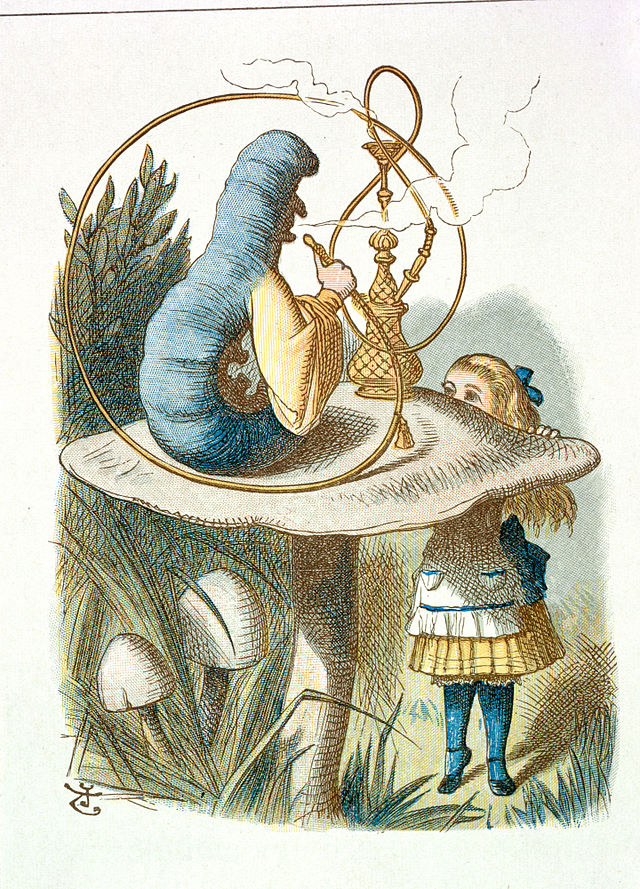
The Past Lives of Lewis Carroll
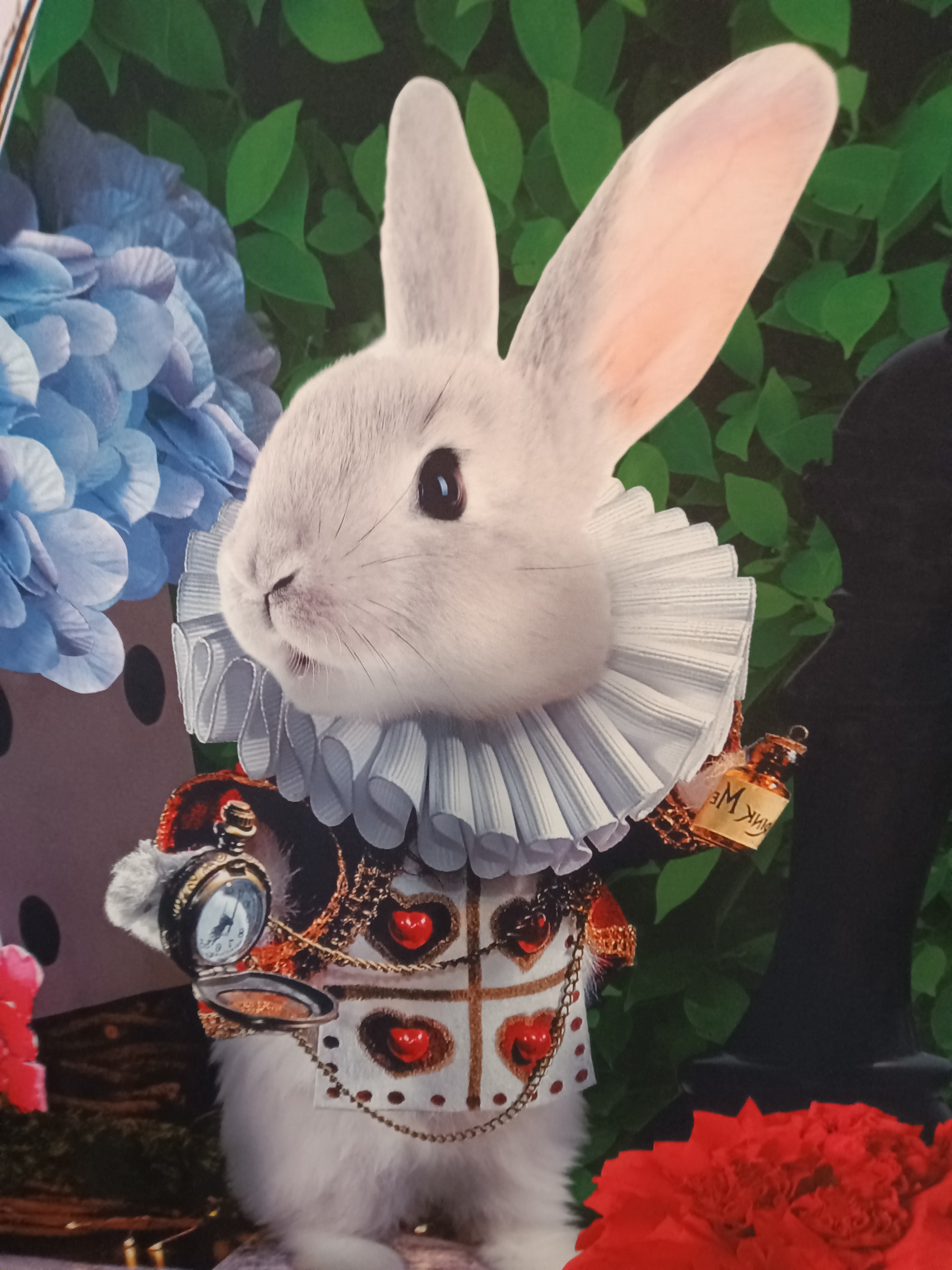
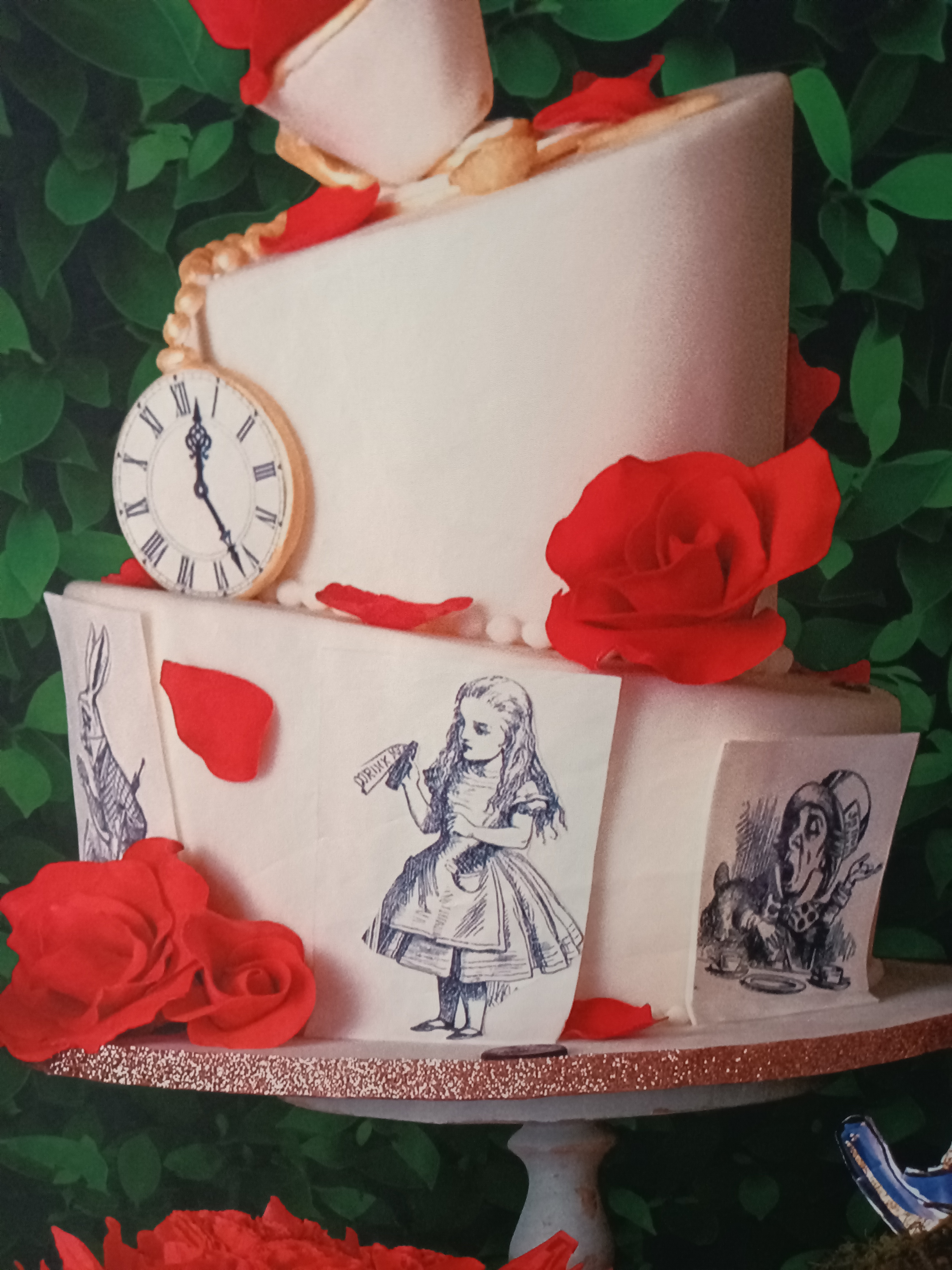
I’ve just finished the edits on Down the Treacle Well, which will be released this fall. Reflecting on the book, I was reminded that its first glimmers had their start in reading a biography about Lewis Carroll. I was intrigued by the real history behind Alice in Wonderland. It wasn’t until after I read the biography below that I read through Carroll’s works.
So I came to Wonderland as it were through the writer, finding him more engaging than the Victorian tale— at least, initially. I’ve also been doing more evolutionary astrology and it seemed natural now to combine the two.
Why not look at the Rev. Charles L. Dodgson (Lewis Carroll) through the lens of evolutionary astrology to get an even more personal understanding of the author who so inspired my new book!
First a little about the man born as Charles Dodgson in 1832. Dodgson was born into a line of English military officers and clergymen. His father was gifted in mathematics as was he. While the father found a home in the high Anglican Church, the son spent most of his life teaching at Oxford. The world would also come to know the son as the writer of one of the most recognized English language works of all time. Alice’s Adventures in Wonderland was published in 1865. Through the Looking Glass followed a few years later. Adopting the pen name Lewis Carroll, Dodgson became famous for his fantasy works and a category of writing known as literary nonsense (Jabberwocky, The Hunting of the Snark).
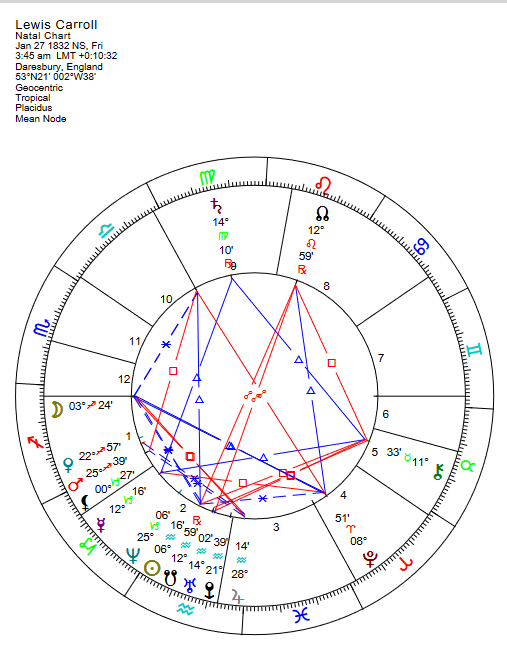
What can evolutionary astrology tell us about Dodgson’s past lives? Evolutionary astrology begins with the premise that we all have lived many lifetimes and that we evolve spiritually through the many lessons we encounter along the way. To understand the themes associated with anyone’s past lives, we must look to the south node in the birth chart. Carroll’s south node is in Aquarius (2nd House). Let’s begin there because it reveals much about him.

The Aquarian South Node:
With the south node in Aquarius, his past life experience was one where he was an outsider, a rule breaker. Aquarius’ modern ruler is Uranus, known for lightning-fast change and rebellion. It rocks the predominant paradigm to bring about the future. He was part of that energy of evolution or revolution. In some sense, he would have challenged conventional reality and its power structure with new ideas and new ways of doing things, perhaps just by being himself. Being different often threatens the existing power structure. He may have often felt lonely and as if the world was against him. The Aquarian south node has strong themes of individualism and thinking for oneself. He would have questioned what other people easily accepted at face value. His chosen path would have formed by deep questioning and a reliance on individual expression. He would have sought and found his own truth. Guided by this, Carroll in his past lives found the courage to define his own story. He may very well have found himself at home in subcultures unfamiliar to the general public.
The danger in this nodal pattern is that the rebel lifestyle with its outsider association can become an identity that outlives its utility. Did he continue to identify with the ideas and causes that labelled him a rebel? Even if that wasn’t a problem, there was a risk in him becoming so caught up in ideas that he became too far removed from other people and life.
Human societies do not tolerate differences well. Sometimes, an Aquarian-type individual can exist within the establishment and adjust enough to get along. However, there are many times when society imposes conformity in all sorts of ways. Past lives where the soul retains memories of persecution, confinement, or torture may lead an individual to dissociate from feelings. There can be a preference for thinking over feeling. The disconnect from feeling can create a wedge in relating to others.
How does this connect to the life of Lewis Carroll?
In anyone’s chart, the south node is our comfort zone. It is what we know and what we are most familiar with. Generally, we tend to stay fixed in this energy and repeat these patterns over and over.
With Carroll’s life, many of the Aquarian markers were present. He has a brilliant mind and loved to engage in fantasy writing, word play, mathematical puzzles and games of all kinds. He lived alone and never married. While he had wide social circles, he spent considerable amounts of time by himself—often walking alone miles and miles every day. Carroll identified as a Christian and rose as a high as a deacon in the church but never assumed the role of clergyman. To this day, no one knows why he refused to take his final ordination. It should have cost him his position at the university and yet he alone was allowed to stay on having refused the requirement. Choosing an academic life, he rejected his father’s path of parson by remaining a bachelor teaching don in residence at a college. Although this arrangement was typical for the time for academics, we might view this as a subculture of society because most of Victorian society did not eschew marriage and family. Lewis Carroll also went on to produce a highly distinctive and individual body of literary writing. So unique was his work that it continues to influence our culture today. His writings are still widely read in their original form. Lewis Carroll societies exist around the world. Not as well known, but certainly Aquarian, are the many inventions he created over his lifetime. He created several practical devices, ciphers, games, and even proposed alternative forms of parliamentarian representation.
The South Node in the Second House:
Recall from above that Lewis Carroll’s south node was located in the second house of his chart. That gives us insight to the kinds of life experiences he had in his past lives. The second house is generally associated with money, self-worth, and values. It is the house that indicates how resources are made available to us in life. Was a person wealthy or poor? Prone to sudden reversals of fortune? All of those are second house concerns. In Carroll’s chart, Uranus (the planet of surprise or sudden upset) is conjunct his south node. This indicates that his resources were vulnerable to unexpected changes. We can easily imagine that challenges to physical or spiritual survival affect the soul. Especially where the repeat of such stress shows itself many times. This is when the soul can become fearful—full of self-doubt and insecurity.
Situations of having to fight for daily survival focuses our attention on the basics of life. Dreams and aspirations go by the wayside. Life becomes a compromise where existence is the only goal. The soul becomes weary feeling cheated out of life. Human dignity is degraded in this experience. Doubt in our own abilities and in the world’s ability to provide reigns. Failure can feel fated if all we know is deprivation.
How does this connect to Carroll’s life?
The Rev. Charles Dodgson was living a quiet academic life when he happened to meet a neighbor of his. That neighbor was the college dean’s wife, and they became good friends. Oftentimes, he and another college friend took the Dean’s children out for the day. On one of these occasions, Dodgson crafted a particularly enchanting tale that one of the children, Alice, begged to have written done. Eventually, Dodgson complied. He also went on to share the story with another friend who encouraged him to seek publication because his own children became very fond of the tale. The publisher immediately liked the book and once it went to print, it became an immediate success. Dodgson became Lewis Carroll. He didn’t spend years as a frustrated, unpublished author. He became an overnight success such that Queen Victoria became aware of who he was and wanted his next book dedicated to her. The money flowed as well. His fan mail quickly overtook his ability to reply. Uranus had touched him, and a series of events led to a complete reversal of his fame and fortune. For a generally shy and reserved man, this probably came as quite a shock and brought its own struggles. Wealth or poverty brings countless changes.
What we have examined briefly here are the way patterns of past lives tend to repeat in one’s current life. That was certainly the case with Lewis Carroll. His soul’s challenge was to move toward the opposite energy of Leo (8th House). To move away from patterning and familiarity takes an enormous amount of insight, dedication, and hard work. However, that was the task set for that incarnation. This is just a brief glimpse into evolutionary astrology. A complete analysis of relevant aspects would give us far more detail into the situational and personal dynamics of his previous lives. However, this gives a taste of the kind of information that can be gleaned quickly from a chart.
If you are interested in what your own chart might reveal, contact me below. Clients continue to report surprising correlations between evolutionary astrology reports and their current life experiences. This is going to be a highly transformative time as we enter the summer. Several key astrological aspects are happening bringing in fast change. Understanding the full context of these changes in light of one’s own personal karmic history is often beneficial.
ASTROLOGY SERVICES:
Click here to find my books: https://amzn.to/2TZOB9h

Filed under Books
Cherry Blossoms in Japan
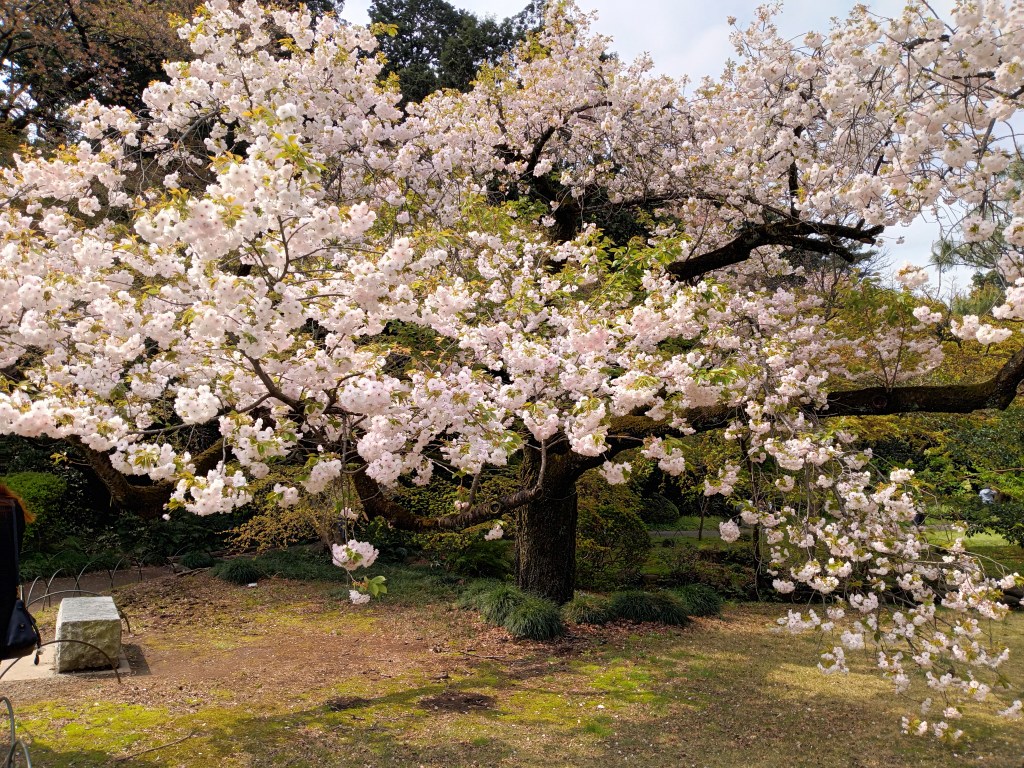
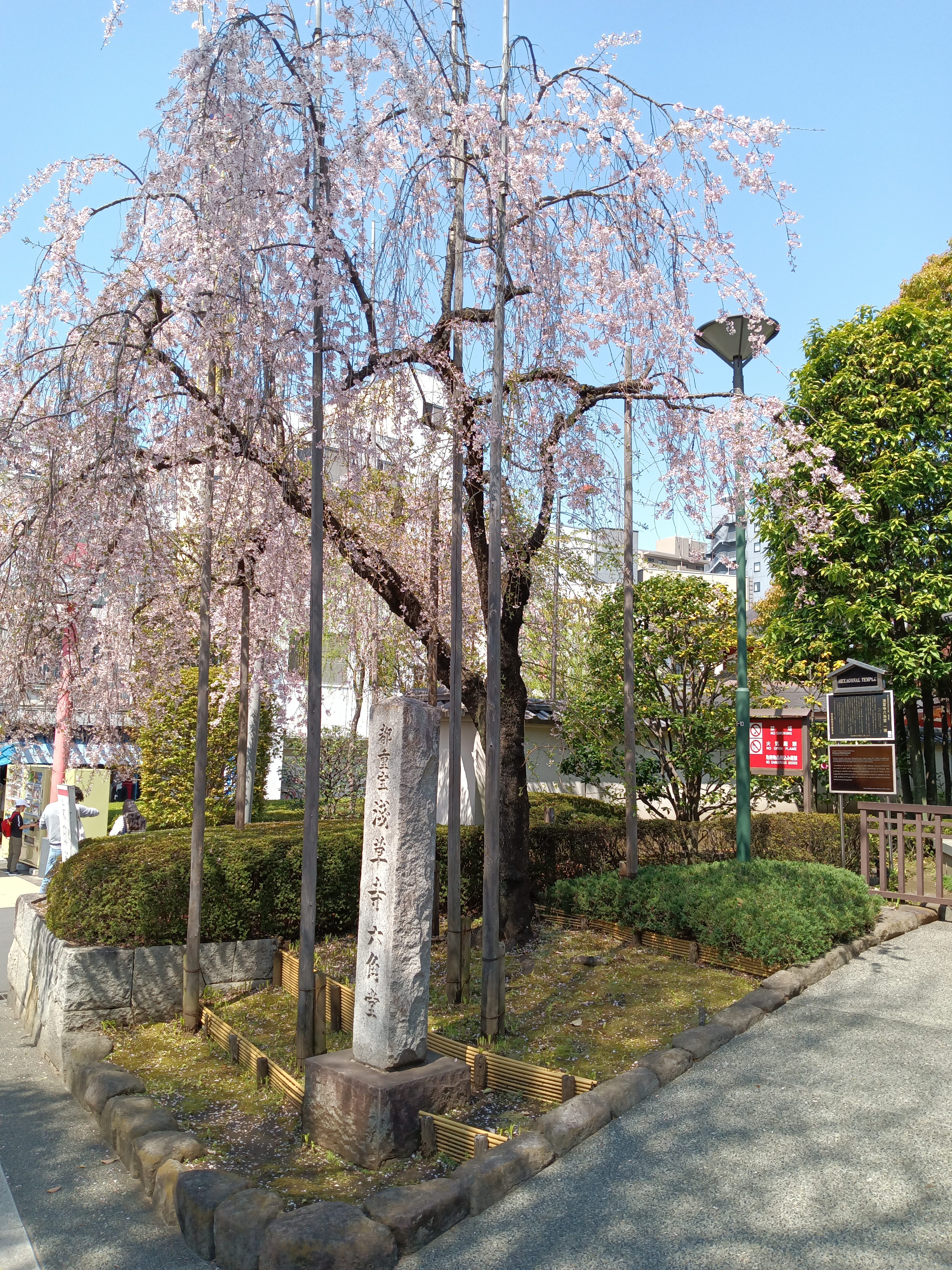
In early April, we were in Japan for cherry blossom season. Once upon a time, many varieties of cherry blossom flourished in the land of the rising sun. But like everything else the coveted tree was subject to change. Diversity gave way to a preference for one variety and a neglect for all the rest. By the 1880s, cities were already showing a marked dominance for that kind of pretty pink tree, absent early green foliage. Japan planted millions upon millions of them and monoculture took hold. These are those fabulous branches of blossoms that frame quintessential photos of Mt. Fuji or geishas on bridges. And they captivated me, too. After all, we had seen tulips in Holland and lavender in Provence…

In Japanese culture, cherry blossom season marks the beginning of new life, new starts, and all new things. School children start new term, promotions and new jobs begin, nature springs forth. It makes sense. Families take blankets into parks and spread them under the cherry trees to have picnics. The blooming season for most trees is short, eight days. A reminder that human life is short too, don’t waste it. As we traveled to various regions, we would catch the trees in different parts of the life cycle. And although monoculture has left its imprint, we did spot some different varieties in botanic gardens and wild places. On one mountainside, my husband thought he spied low-lying clouds only to be delighted by a wild plot of white, cherry trees mimicking clouds. And I fell in love with the wispy, weeping cherry form.


FOR MORE, CHECK OUT THESE BOOKS:
The Sakura Obsession: The Incredible Story of the Plant Hunter Who Saved Japan’s Cherry Blossoms by Naoko Abe (story of Collingwood Ingram, an Englishman who became a leader in saving cherry trees and assuring species diversity by sending specimens throughout the world.)
Cherry Blossoms in Japan by Partha Protim Hazarika (photos)
Cherry Blossoms of Kyoto: A Seasonal Portfolio by Kodansha International (editor), Hidehiko Mizuno, Kayu Mizuno
(photographers)
To find my books, click below:
ASTROLOGY SERVICES:
Filed under travel
THE DEAD OF WINTER
(Three Giordano Bruno Novellas)
SJ PARRIS
SJ Parris has written three novellas on the early life and adventures of the Dominican Friar, Giordano Bruno. In The Dead of Winter, we find Bruno uneasily settled at San Domenico in Naples in 1566. Bruno’s curiosity draws him deeper into philosophical questions and the nature of the healing arts. He has a penchant for asking uncomfortable questions and an ability to pierce mystery. Learning medieval medicine soon brings him into contact with others who seek deeper knowledge. In dark times, that means powerful men in secret societies who run risks that this young priest finds irresistible. A forbidden autopsy, murder, and countless secrets swirl at San Domenico and so do the politics of power. It will take Bruno’s keen intellect to survive.
This is a nice addition to accompany the other full-length novels Parris has done on Bruno.
To find my books, click below:

ASTROLOGY SERVICES:
Filed under Books
Musings on Covid: Past & Future
As the Covid years unfolded, it became apparent that the magnitude of its significance would not be known for many years, perhaps even not until well after my own death. Certainly it felt like the most important event I ever lived through which says a lot. Having been born in the 1960s, I’ve lived through the turbulent social changes of that time, the moon landing, Vietnam, 911, the Gulf Wars, and currently the divisions between the right and left political factions that led to the Jan. 6th, 2021 Insurrection at the Capitol. While all those events were important in their own ways, many of them felt distant or impersonal. Covid, while experienced differently for everyone, left no American untouched. Not really.
I chose to end a family history document of the event in the fall of 2022, but this was an arbitrary choice. There has been no concluding event that signals an end to Covid. Although a national memorial service was conducted at the Lincoln Memorial the day before Pres. Biden was sworn in (Jan. 19, 2021), the country has not yet fully grieved the losses and changes associated with the pandemic. In many ways Covid is not done with us. We still don’t know the full ramifications of how the pandemic has changed us as individuals (i.e.. the actual virus in our bodies) or as a society. The impacts of Covid are more than disease and death. It will be years before we have understood the ramifications of this event.
What can I say about being alive at this time? Overall, there is the pervading feeling that we failed. The challenge of Covid was an easy one. We had an enemy in the form of a disease that should have pulled us together as a nation and rallied us to fight a pathogen. It didn’t. Instead, it served as a wedge allowing some parts of society to try to undermine legitimate government and actively spread misinformation for political gain. Science and vaccines became enemies. People died as a consequence. Americans were poorly served by President Trump who had no desire to lead and who was clearly the wrong man for the times. The federal government was too slow, too unprepared, too disorganized to respond to a worldwide pandemic that everyone knew would eventually one day occur. We learned too late that the Center for Disease Control (CDC) was not the best organization to lead in an unfolding emergency. Leadership did emerge at the state level where we witnessed several governors step up to the task of leading. Notable among them were New York’s Gov. Cuomo, CA’s Gov. Newsom, and CO’s Gov. Polis. At the same time, we saw awful behavior among some governors who fought mask mandates, vaccines, and often reopened their states in defiance of health guidelines. In terms of infection and death rates, blue states (led by Democrats) fared better than red states (led by Republicans). This is due to the fact that Democrats believed there was a pandemic and that vaccines were a legitimate tool to fight infection. In general, Republicans were skeptical about Covid and often rejected vaccines and health policies advocated to fight the spread of the disease.
It must be remembered that the Covid years were experienced differently for people. Where you lived made a difference. People residing in New York City bore the early brunt of the first wave, suffered huge casualties, and witnessed triage methods that prioritized who would get treated. Nursing homes and residential care facilities had outbreaks that ripped through them. They were closed off to visitors and family. Many died alone. We all saw the videos of family members outside of windows waving their last goodbyes or Skyping them. While the elderly were the most vulnerable to the actual disease and death, even the young were heavily impacted. Schools were severely disrupted. Outbreaks caused schools to send students home. Many schools went to online models of instruction. Some used a hybrid of in-school and online learning. Not only did academic achievement suffer but so did student mental health. During the Covid years of physical separation, all age groups flocked to social media as a way to communicate. Not too surprisingly, mental health challenges increased, and social isolation will have to be something seriously considered for the next pandemic.
Although there seems to be a feeling that Covid has changed us, you get the sense that most Americans want to forget the experience as fast as possible. This happened during the 1918 Flu Pandemic as well. So pervasive was that forgetting that contemporary audiences only recently rediscovered that period of history as we became aware of the likelihood of another pandemic around the time of SARS (2003). The forgetting (I feel) is fully underway now. In searching for a book to give a broad sociological framework to the Covid experience, I could find none. There are books on the medical failures and personal accounts of what was experienced. So I was left to my own devices to address areas that seem relevant and likely to be impacted as we go forward. To be sure, history will write its own assessment of this time. It is important to understand that living through the experience is not the same as evaluating successes and failures after the fact when all the details are known. By and large, the average American was making decisions regarding risk in a world where the facts were not known. Most of us did the best we could. Some were led astray by misinformation. This was not without consequence, unfortunately.
Certain changes and trends have come about during the Covid years. Some of them were already underway and some are entirely due to the pandemic. Regardless, Americans will feel these changes.
While my family history document focused on how events unfolded in the US, the pandemic was worldwide. As a result, there were disruptions in supply chains throughout the Covid years that were unpredictable. It was not uncommon to wait for months to get building materials or furniture that came from abroad. The need for medical supplies the nation needed throughout the crisis was often exasperated by the fact that we had not stockpiled the items and did not control the manufacture of them either. So while, it felt like we were moving toward a global economy, Covid made us rethink how our interdependence on foreign suppliers was in fact crippling (especially when the whole world wants those very things at the same time). Perhaps we should be less dependent or so the thinking goes.
One of the primary areas that went through a significant rethink during this period was how Americans work. Covid forced many in service-related industries out of jobs for prolonged periods. Many of the jobs in food and hospitality never came back. Other workers (generally the better educated or computer-based services) were sent home to work from a home office. Work from home had long been proposed going back to the 1980s but never made much gain. Covid was the opportunity to see it launch and launch successfully. So popular was it, that when employers wanted workers to return to the office, it was met with resistance. Time at home gave people the ability to reevaluate the work/life balance. No longer were old work paradigms meeting today’s workers’ needs. The waves of change continue to ripple through the workplace. As they do, they spill over. What will urban landscapes look like if workers do not return to office buildings? Downtown shops and restaurants may need to adapt as business shifts to a more decentralized model. How do suburban neighborhoods change to serve the needs of stay-at-home workers or do they? What new forms of social and entertainment structure will develop as a result?
Although Americans had previously embraced online shopping, Covid forced us online in ways no one could predict. We came to rely on suppliers like Amazon, FedEx, UPS, and others to receive goods when we were in lockdown and beyond. These workers became “essential workers” and we grew used to seeing them in our neighborhoods on a daily basis. As local shortages in stores manifested, we often took to the internet to scout out suppliers and have them delivered. Contactless shopping modes developed during this time. Ordering locally and waiting in the parking lot for your groceries or food to arrive kept us safer during Covid. This limited our exposure to other people (and potentially the virus). Other kinds of stores like hardware, office supply, and craft stores also had pick-up in the parking lot. It is interesting to note that during this period it was not uncommon to sit in the parking lot and wait to be called inside for doctor or veterinarian appointments, as well. Some of these modes of shopping continued beyond the crisis and proliferated after the pandemic’s height. With the retail market under severe pressure, many stores and especially restaurants closed permanently. There is no doubt that where and how we shop is undergoing massive change.
Early in the Covid crisis, as more and more people were sent home, certain expectations arose. One was that the birthrate would skyrocket. That never happened. The economic and life-threatening nature of the crisis gave Americans pause over everything. Birth rates declined. Marriages were put off. People hesitated about selling their houses or making long-term decisions. Holiday events, reunions, graduations, and funerals did not happen. Yes—people were buried but sometimes with only a few family members present because we were not allowed to gather in groups during some periods of the pandemic. Many of life’s milestones went unmarked. This also must be factored into the mental health toll.
Even as I write this in 2023, we do not know the real numbers of dead. There remains some uncertainty over when the virus first hit America. In addition, there are anomalies on data collection between the states and amongst the various data sources. Some people who got Covid did not recover in the usual way, and they were given the illness tag: Long Covid (now called post Covid19 by the World Health Organization). The medical community is trying to understand the symptomology and prevalence of the condition. However, at this point, not much is known. Some are severely impacted. We await more information on the various vaccines (any long-term effects on the body, if any, which are unknown at this point) and of the virus itself. We still don’t know the exact origin of the Covid virus. Much speculation occurred over whether the virus came from a lab or wet market in China, or some other source. No doubt, science will reveal much more about all this. During 2019-2020 life expectancy dropped 1.5 years largely a result of the Covid19 pandemic (from 78.8 to 77.3 years). It was the largest one-year decline since WWII.
The one truly remarkable victory of this time was that the US, through the private sector with government subsidies, produced several effective vaccines within a year of the contagion. Masks, social distancing, shutting down, and eventually the vaccine, curbed the spread of Covid and prevented death. Going forward, it should be a cautionary reminder that Covid had a relatively low death rate. Even so, American hospital resources were quickly outstripped as waves of the disease hit. Factions of the American public resisted public health efforts encouraging vaccination and vaccination skepticism (fed by misinformation) continued. Higher rates of spread and higher death rates in future pandemics would likely lead to worse outcomes.
Lastly, there’s an attempt in Colorado to have some kind of memorial built to honor the 15,000 people who died in our state during the pandemic. It seems like a good idea but there also seems to be a need to do something nationally. The first permanent memorial for Covid-19 victims was established in 2021 in Wall Township, New Jersey. The modest display consists of 6000+ hand-painted rocks arranged in hearts and mounted in frames. Noble as the effort was, surely over one million American deaths require a larger, dedicated effort.
Filed under Covid-19
POPE JOAN
by Donna Woolfolk Cross
Although denied for centuries by the Church and some scholars, Donna Woolfolk Cross, has written a convincing fictional account of a ninth-century woman Pope. Her notes concluding the novel outline her credible sources for why she believes Joan did in fact exist. Her choice to write fiction was based on there not being enough known about Joan to write an extensive biography. Nevertheless, she makes a good case for her existence in a time when few records were kept and very little is known about the time period. Joan’s story comes to us through persistent legend and uncanny Church practices.
The novel plunks the reader down in a foreign age where women are not only second-class inferiors but brutally treated. Possessed of an inquisitive mind, Joan immediately resents living in a household where her brothers are educated to rise in the Church and she is left to menial housework. Her only eventual task is to marry as well as she can. Opportunity comes when her brother dies during a Viking raid, and she seizes the chance to disguise herself as a man and enter monastic life. Once established, she excels as a scholar and healer. Turbulent times eventually lead Joan to Rome and all the way to the papacy.
Cross’ book roughly follows the legends that have come down about Joan. The tale is well-written and engaging. Modern audiences can well imagine the motivations of someone who wants more for themselves and acts to defy convention and take advantage of opportunities as they come along. The story is a triumph of the human spirit striving for expression while the darker forces of others are at work here as well.
To find my books, click below:

ASTROLOGY SERVICES:
Filed under Books
A Forest of Trees
My local library in Colorado has trees decorated with book themes this month. There are over a hundred of them. Here are a few.

Charlotte’s Web

Chronicles of Narnia 
James & the Giant Peach 
Sesame Street 
Fancy Nancy 
Harry Potter
(Above) The Great Gatsby, James Bond, Manga, Queen’s Gambit, World Records
(Above) Mexican Gothic, Dinosaurs, Ready Player One, Jan Brett, Charlie Brown
To find my books, click below:

ASTROLOGY SERVICES: