Tag Archives: spirituality

DO YOU HAVE A GRATITUDE PRACTICE?

It’s Thanksgiving again and many will fleetingly acknowledge a few (or many) things they are grateful for today. Maybe you’ll go around the dinner table asking friends and family to share a few words. That reminds me of the year we did that. The kids were little and we had gathered pinecones from Plymouth and I thought it’d make a meaningful ritual to pass a pinecone and mention something we were grateful for. It was a disaster. Everyone was caught off guard and a few adults even seemed offended. How dare I require something of them when the whole idea of Thanksgiving was to stuff yourself to bursting? The pinecones sit at the bottom of a box of fall decorations never to see the light of day again. I learned.

I’ve always been a cup half-empty person. My focus was on a compulsive need to fill up the cup so I could at last be happy. When I achieve the right job, the right income, the right family, the right set of possessions, and the right body – then I will have earned the right to be happy. That’s how I was raised after all. Then I will celebrate and be grateful for having it all. For decades I existed like this (maybe you do too?).

Eventually I did come to understand how toxic this attitude is.

Nowadays, I have a gratitude practice which is simple and has turned me into more of a cup half-full person. Every night I take a few minutes to focus on the myriad of good things in my life. By choosing to see the world this way, I banish thoughts of not being good enough and not having enough. I am good enough and I certainly have enough. That’s blasphemy in our consumer driven, material world. I am a revolutionary. Are you?
98 Comments

Filed under Spiritual/Mysticism

NEWTON AS ALCHEMIST

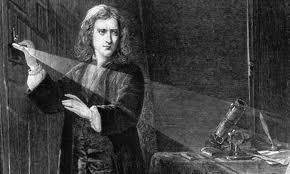
When we think of Isaac Newton, most of us probably return to high school physics. Laws of motion, gravity, incline experiments, and lists of equations come to mind. Newton was a great scientist and collective thought has enshrined him this way. But this is a very modern way to see him and casts aside and discards him as a spiritual being, for Newton was an alchemist. Sir Isaac wrote more on Biblical hermeneutics and occult studies than on math and science. He placed great emphasis on rediscovering the occult wisdom of the ancients and probably considered his scientific work to be of much less importance.

Although alchemy is generally viewed as a precursor to science (and it has that role), it was so much more. Alchemy incorporates Hermetic principles which include ideas from mythology, religion, and spirituality. Below HJ Sheppard outlines the dualistic nature of alchemy as both external (in the material world) and internal (spiritual) practices.

Alchemy is the art of liberating parts of the Cosmos from temporal existence

     and achieving perfection which, for metals is gold, and for man, longevity,

     then immortality and, finally redemption. Material perfection was sought

     through the action of a preparation (Philosopher’s Stone for metals;

      Elixir of Life for humans), while spiritual ennoblement resulted from some

      form of inner revelation or other enlightenment.

 We will probably never know the full extent of Newton’s alchemical work. Much was destroyed by fire. He also worked in a time when many alchemical experiments were banned and religious views differing from what was considered mainstream was heresy. Historians are still trying to piece things together.

An auction at Sotheby’s in 1936 created a worldwide sensation. Previously unpublished and unseen documents (Portsmouth Papers) surfaced and were presented for sale. About one-third of them were considered alchemical in nature. The papers show Newton’s keen interest in the philosopher’s stone. To this day, several projects are underway to catalog, transcribe, and make Newton’s papers available.

Other writings point to Newton’s interest in occult knowledge, sacred geometry, and prophesy. Throughout his life, Newton associated with members of various esoteric groups but his actual membership in any of them has never been confirmed. Certainly he shared many of the same interests these groups had. At the time of his death, Newton’s library contained 169 alchemical books and for its time, it would have been one of the best alchemical libraries in the world.

Recently I read Ghostwalk by Rebecca Stott. This is a fictional story which revolves around Newton’s life at Cambridge. Stott is a professor who bases the book on actual records of Newton’s life. At its core are the mysteries of Sir Isaac’s rise to power and position, a series of murders near the university, and the influence of alchemy. A very interesting read.

58 Comments

Filed under alchemy, Book Review, Spiritual/Mysticism